Showing posts with label family. Show all posts

Monday, January 23, 2012

Loss and Life


This year seems to have started with many friends around me suffering the loss of someone close. A constant reminder of the fragility of life and a sense of fear about how any of us will make it through to old age. Chances seem slim when you hear so many different stories.

Since my father died, I have always found the new year particularly poignant. Another year that he will never know. Another year that pushes him further away from our lives. My greatest fear when he died was that my children would have no memory or understanding of him. His death prompted me to start writing; for the children and for me.

Last week Lily told my mother she had no memory of him whatsoever. Even when she looked at the photos of him holding her as a baby, she couldn’t sense him at all. Yet, when he died and she was not quite two, she talked about him all the time. So much so that her chatter prompted me to write the story below.

A story that not only helped me cope with my loss but more importantly a story I need to read to her again.


(first published in the Sydney Morning Herald, February 22, 2007)
A Shift in Perception

Lily loved her Pa. He was always reading to her. Everytime Pa came to visit, Lily would rush to her bookshelf and find a collection of books to read together. Afterwards they would pull funny faces and make each other laugh. Pa always made Lily laugh and Lily always made Pa laugh. He was always smiling.

Then Pa started to visit a bit less. When he did, he looked tired and was sometimes too tired to read to Lily. Luckily Mama was always with him, so she would read to Lily while Pa watched, still smiling.

Soon Pa stopped visiting at all and Lily’s mummy would take her to visit him. ‘We’re going to have morning tea with Pa today’, she would say and Lily would rush to her bookshelf to find different books to show him. Mostly Pa would be in a chair by the bed, looking out the window. Sometimes he would be asleep. Each time he looked very sad but as soon as he saw Lily, his eyes would light-up and he would give her the widest grins. Lily would run up to him laughing, kiss his cheek and rummage through her bag for her books. Pa couldn’t read to her anymore, so Lily’s mummy would instead. Lily didn’t mind — whenever she looked at Pa while mummy was reading, he was watching, still smiling.

Sometimes he slept while Lily’s mummy read, but he always woke up to kiss Lily goodbye. As Lily walked out of his room, she would turn back to wave and Pa was always watching, still smiling.

One day, they didn’t go to visit Pa and everyone in Lily’s family — her mummy, daddy, mama, auntie and uncle — looked very sad. Lily wasn’t sure why as she could see Pa in the loungeroom with them all. Watching, still smiling.

Lily missed sitting on Pa’s lap and having him read to her. She would often look at her books by herself, only she was never really by herself as she would look up and always see Pa watching her, still smiling.

Sometimes she would try and read her books aloud to him but she couldn’t remember all the words, as hard as she tried. Pa never seemed to mind though as he was still watching, still smiling.

Lily’s mummy was often sad and told Lily it was because she missed Pa. Lily wanted to make her feel better so would go to her bookshelf and find her favourite books. As Lily’s mummy read to her, Lily saw she had tears in her eyes. Lily couldn’t understand why as Pa was there too. Watching, still smiling.

That night Lily had a dream about Pa. Lily was so excited. She could cuddle him and sit on his lap. Best of all, he could read to her again — all the books in her bookshelf! They laughed and laughed together. He wasn’t tired anymore and he was so happy. Lily kept looking up at him as he read. Of course he was watching, still smiling.

After he finished the last book, he folded Lily in his arms and told her he had to go. He asked her not to be sad because it was good. He was all better now. But Lily didn’t want him to go. She wanted to stay on his lap and have him read to her forever. He hugged her and said that every time she read a book to think of him; he would be there, between every word and page. He would point at the pictures and laugh with her at the funny bits, just like always. Then Pa told her it was time to go back to sleep. She nestled her head in the crook of his arm and closed her eyes while he watched, still smiling.

In the morning, Lily raced to her bookshelf to find her favourite book and sat down to start reading. Straight away she felt Pa next to her but when she looked up he wasn’t there. She kept reading though, always thinking about him. And Pa continued to watch, always smiling.

Wednesday, December 7, 2011

How organised are you?


Have you ordered the turkey yet? Written the Christmas cards? Bought the presents? I haven’t. It just doesn’t feel Christmassy yet. Perhaps that is due to the unseasonably cold weather in Sydney at the moment but then I look at the calendar and realise we are hurtling towards the middle of December! School breaks up next week!

Instead of writing lists, ordering the turkey, braving the shops or buying those cards I recently chose another way of getting into the Christmas spirit. Sitting – alone – in my favourite bookshop / cafe I picked up a copy of the newish book Cooking for Claudine by John Baxter.

For anyone who loves food, wine and armchair travel, this is the book for your Christmas stocking. John Baxter is the acclaimed Australian film critic who, many years ago while living in America, fell in love with a French woman and followed her to Paris.

For the last 18 or so years, he has also cooked Christmas lunch for his French in-laws, a French family ‘with roots so deep in the soil of medieval France’, living in a ‘country house dating from before Australia was even discovered’.

This memoir collects vignettes from previous Christmas lunches and journeys around France to source ingredients for the big day. Throughout are wonderful observations of this family’s love affair with food:

“ ‘We could pick up the cheese.’ Even as I said it, I recognised I’d made an error. The French approach cheese with the reverence the Spanish accord the corrida, Americans baseball and the English their tea. It is not to be ‘picked up’, or grabbed, snatched, or scored, nibbled, scarfed, or snacked on...”

In fact, Baxter has a whole chapter devoted to cheese, including this piece of trivia:

“To Charles de Gaulle, the diversity of French cheese was evidence that France was in robust political health and in no danger of becoming, as some people feared after World War II, a Communist nation. ‘How can one conceive of a one-party system,’ he asked, ‘in a country that has over two hundred varieties of cheese?”

And what happens if the piglet you decide to roast for Christmas lunch is too big to fit in your oven?

“No meal of this magnitude would fail over a few centimetres of snout.” Baxter says. But does it?

Family heirlooms are brought out for the day – the generations old silverware, the linen tablecloth bought at a market for 10 euros – the ceremony and ritual that preparing the Christmas meal brings that every reader will relate to.

As Baxter writes, “Proust was right. Any house or garden or town existed only as the sum of the feelings experienced there. It was remembering history and maintaining tradition that kept the material world alive.”

An enjoyable, tasty read. Enough to get me to the butcher to place that turkey order.

Cooking for Claudine
by John Baxter
Faber, $22.99

Wednesday, November 23, 2011

Was a Casserole enough?


Ah, it seems Matthew Evans and my chicken & sage casserole has finally broken the curse of the infamous duck risotto.

Not only did my sister's date love it, he asked her for the recipe.

I like the sound of him even more.

Monday, November 21, 2011

A Reliable Recipe – I hope


My sister has been single for a couple of years now and a whole new world of dating has opened up for her (and me, vicariously). At different times she has met very different men, gone on a few dates, cooked a meal for them and – despite how different these men have been from each other – all dates have ended after this meal. The same meal she has cooked each time – once her signature dish, one could say – until she saw the pattern emerge.

‘I can never cook it again,’ she laughed, ‘unless I want to get rid of someone.’

What is it, you are probably wondering?

Duck risotto. A very rich, very tasty duck risotto that she has even cooked me. Restaurant quality I thought. It didn’t ruin our relationship (and hopefully this post won’t either).

She’s a great cook and it’s an impressive meal so we have decided it must just be a funny coincidence... but as superstitious as our family is I know she will never cook that duck risotto for a man again.

That has been fine the last few months, but not now. She has met someone; someone who (big sister thinks) sounds better than all the others put together.

There have been numerous dates and now we have reached the home-cooked meal one. I say ‘we’ because I have never really been in this position. When Stuart and I started ‘dating’ my mum cooked him dinner. That’s how young we were.

Late yesterday, I received a text from her asking for my chicken and sage casserole recipe. Perhaps you could call it my signature dish. I’ve cooked it so many times that Stuart is over it. That minor point aside, it’s a really easy, simple dish that does looks impressive.

I had given my sister the recipe a few years ago but she couldn’t find it anywhere.

‘Maybe it’s a sign you shouldn’t cook it for him?’ I text back.

‘Don’t say that?!?!?!’ came the swift reply.

Fair enough. I went to find it in my recipe scrapbook. I tore it out of Good Weekend magazine years ago when Matthew Evans had the ‘Weekend Fare’ column. I hadn’t looked at the recipe for a while either, given it’s one of only a handful I know by heart.

As I started typing the method out, I noticed the introductory paragraph he’s written above it.


“Love. As fragile as meringue. Women. As tender as slow-cooked chicken thigh. Feelings. As easily bruised as fresh herbs. Memories. Lightly salty, like tears. A good casserole. As reliable as an old friend and as warming as a hand on your shoulder.”

It has to be a sign...

This and the fact that on their first date he mentioned a strong dislike of risotto.

Only time will tell.

Chicken casserole with mushrooms and sage
(serves 3-4)
25g butter
8 chicken thighs
Flour for dusting
1 leek chopped
1 cup white wine
200g button mushrooms
15 or so big sage leaves
Salt and pepper

Method
Preheat oven to 150°C
Dust chicken with flour.
Melt butter and brown chicken in an oven proof dish.
Remove chicken and fry leek until it’s softened.
Return chicken, add wine to deglaze bottom of pan and simmer for a minute or two.
Toss in mushrooms and 10 sage leaves, salt and pepper.
Cover and put in oven for an hour or so.
Add remaining sage leaves and serve.

*Recipe by Matthew Evans, torn from Good Weekend circa 2004

Friday, July 29, 2011

When Home is... Eating Well. An Interview with Cookbook Author Kathleen Gandy


It’s Sunday morning, you’re about to face the weekly grocery shop but you are 10 weeks pregnant, feeling sick and tired. You love cooking and food but you can’t bear the thought of meat or standing over the stove for hours preparing meals. You barely have the energy to make it through a week of work, let alone a week of cooking dinner.

Or, it’s Sunday morning and you have to somehow squeeze in the grocery shop between kids soccer games, ballet classes and birthday parties. You remember the days when you spent weekends reading through cookbooks, preparing dinner parties and meandering through farmers markets with a coffee in one hand and a bunch of flowers in the other. Now you are struggling to think of meal ideas beyond spaghetti bolognaise. Anyway, who has the time?

It’s a dilemma everyone faces during the years of pregnancy and raising a young family; even cookbook editor and author Kathleen Gandy who has always loved cooking and turned her passion into a career.

‘I always loved reading as a child, applying for my first library card when I was five and I always loved food. My mother is Cantonese and I grew up surrounded by that food culture. Later when I went to boarding school the food was awful: boiled chicken, boiled potatoes, boiled cabbage. I’d look at it and cry. When I’d go home in the holidays, mum and I would plan our days around meals rather than activities.’

After working as a recipe developer and food writer, Kathleen joined Gourmet Traveller’s food team. Then she fell pregnant with her first child. While researching what she couldn’t eat she decided to focus instead on all the foods she could eat.

‘There were so many different cuisines. I had never been a “food is fuel” person and even though I suffered morning sickness I still looked for pleasure in my cooking. As Nigella Lawson once said “there is no excuse to eat a bad meal”. I kept a food diary of all the meals I ate and felt like during the different trimesters of pregnancy and realised, while looking for different recipe ideas, that I wanted a book that celebrated all you could eat during this joyful time. I was completely overwhelmed by the What to Eat When You’re Expecting-style regimen of calculating and combining units of food groups.’

So the idea for a foodlover’s guide to pregnancy developed. Kathleen’s first book, Eating for Two, was published last year in Australia and will be published later this year in Germany.


‘The recipes were developed from the perspective of flavour first. All are simple and quick to cook as I found cooking smells difficult to deal with during both my pregnancies. I wanted the book to speak from a shopping list point of view rather than units of food, so at the beginning there is a list of pregnancy superfoods that form the basis of the recipes. They are the superfoods I still buy weekly.’

While all the recipes and information were checked by an accredited practising dietitian and written within the Australian food safety authority pregnancy guidelines, Kathleen emphasises that this is not a ‘health’ book as such.

‘It’s more a celebration of that exciting time in your life by highlighting all the fabulous things you can still eat. I approached my dietary needs of pregnancy through the eyes of a guts. I love eating; why should pregnancy be any different?’

And why should mealtimes with a young family be any different as well?

‘The recipes are very "family friendly" and have come to form the basis of my ongoing weeknight repertoire, as they are healthy and generally fast to prepare. My kids have particular favourites (I guess they got a taste for some of the flavours during pregnancy).'

Pregnant or not, particularly helpful are pages such as ‘Ten things to do with a packet of pasta’ or ‘Ten things to do with a can of tuna.’ Who has ever stood in front of their pantry wondering what to do with a lone can of tuna or realised that the pantry is bare aside from a packet of penne?

But if you are pregnant, it’s hard not to go past the ‘Ten quick fixes for morning sickness’ page.

‘The book is authentic to my food experience of my two pregnancies – I kept notes of recipes I created to deal with the different phases such as morning sickness, carpal tunnel syndrome, heightened sense of smell; and cravings (citrus was big, hence the citrusy salads). I also went through a protein phase, where I just wanted to eat loads of meat.’

After the book was published, Kathleen began a blog titled Next Week’s Dinner which tackles the stresses of menu planning. Working fulltime as a senior cookbook editor with a six-year-old and four-year-old who need to eat by 6pm, Kathleen quickly realised how organised she would have to be to get dinner on the table every night.

‘The blog came about as an extension of my life now,’ says Kathleen. ‘I am lucky to have 45 minutes to prepare dinner. There are no shops on my way home, so I have to know what I’m cooking beforehand.’

As she writes on the blog’s ‘About’ page, ‘On the spontaneity–stress-relief continuum, meal planning literally saves my bacon every week.’ The blog acts as a food diary, recounting the family dinners eaten each day and also how sometimes the plan goes straight out the window.

‘Rules are made to be broken – if my train is cancelled it might just be that we eat pasta on Thursday night instead of Friday, or say there’s a school event in the middle of the week, I may just dish up the re-purposed Sunday night leftovers then instead of on Monday.’

The blog is a great read for anyone who is sick of worrying about what to cook for dinner or has stood in front of a full fridge or pantry and feels like there is nothing to eat...

‘What is most important to me about the book and now the blog is that they are authentic and capture my everyday experience; how the daily act of nourishment and a love of good food intersects with family life,’ says Kathleen. ‘The two are not mutually exclusive.’

For more information about Kathleen’s book, Eating for Two, click here.
To read Kathleen’s blog, Next Week’s Dinner, click
here.

Author Image by Richard Birch
Cover image, Eating for Two by Kathleen Gandy, photography by Mark O'Meara, published by Viking, RRP $35


Tuesday, April 19, 2011

When Home is... Full Bookshelves


This happens every year. The bookshelves are filled and no more books can be stacked sideways on top of others. It’s time to be ruthless and work out which are worthy to stay and which are on the way to Vinnies or the School Fete.

Usually I do this job alone and it doesn’t take too long to pick a pile of paperback fiction that I can live without but this year something different happened... Stuart. While innocently out having coffee, unbeknownst to me, he was busy making piles – ‘suggested’ piles – of books to give away. The suggested pile was chosen with common sense in mind but no emotion.

It was then that I realised books not only give a room its soul but they also act as markers of our history, they help shape the story of the people we become. They are yet another expression of making our homes truly ours.

Ok – I know I will never need to use my pregnancy books again or Robin Barker’s bible Baby Love but I still want to see the bent back spines of those books on the shelves, remembering how thumbed through they were. I like seeing the folded back pages in Baby Love reminding me that, yes, at three weeks old babies properly wake up and cry for substantial periods of time and that’s normal. It was hell at the time but now I fondly remember turning down the corner of that page at 2am one morning with three-week-old Lily screaming in one arm while I held the book in the other.

And as for fiction; I agree that my shelves filled with Virginia Andrews complete collection – and dare I mention Penny Vincenzi – may cause visitors to wonder how I became a book editor or why any magazine would ask me to write book reviews, but these books are such old friends. At least my Sweet Valley High collection is hidden under the bed...

I haven’t read Flowers in the Attic since I was 14 but it was within these pages I discovered the power of reading and the pleasure of escaping into another world. I like remembering that excitement and I don’t mind that it’s on display for all to see. They may take up nearly a whole shelf but they are staying.

So while Stuart’s ‘suggested’ pile went straight back on the shelves I still managed to get us back to full capacity rather than over capacity.

Interestingly, my ‘suggested’ pile for him also went back on the shelves. Funny how common sense goes when it’s about pulling apart your own story. I don’t think he’ll be reading Tuning a Racing Boat, Three Sheets to the Wind, They Ran with the Ball or The World’s Best Rugby Book Ever again but there they sit.

Tuesday, March 22, 2011

When Home is... a Toddler without Day Sleeps


It’s been a week between posts. Sadly the quietness hasn’t been due to an inundation of freelance work, a book offer or a busy social life. Instead it’s due to very little time alone and a very moody toddler who thinks he doesn’t need to sleep during the day anymore.

My predictable time off in the middle of each school day is no more and it has reminded me of how I felt a few years ago when I was going through this ‘transition’ (for us both) with Ned. History is repeating itself in our house and below is a piece I wrote for Sydney’s Child a couple of years ago which reminds me that this is just a phase... and home will not stay this way forever...

No More Naps (Published in Sydney’s Child magazine, February 2009)

I nervously look out my French doors towards the garden as I pour water into the coffee plunger and my friend chats obliviously. It’s four o’clock on a Friday afternoon and my two-almost-three-year-old son is running around in circles laughing maniacally. This is not a good sign. As my friend’s daughter, of a similar age, bends down to pick up his toy lawnmower, my son lunges, pushing her roughly and shouts indignantly — as only a two-year-old can — ‘No, that’s MINE!’

After the fracas is resolved, I turn to my friend apologetically, ‘He didn’t have an afternoon sleep.’ She nods, smiling empathetically.

*******************

The day begins well; with his older sister at preschool we enjoy a bit of shopping followed by morning tea at a café, an elaborate fantasy game with fire engines and diggers, lunch, and three picture books before bed. I come downstairs looking forward to a couple of hours of quiet, or perhaps more honestly, Oprah and a cup of tea. But then I hear a little voice singing. It’s the theme song of his favourite cartoon about a fire engine.

‘Stay calm’, I say to myself, ‘It won’t be long before he drops off. He looked tired enough.’ I turn up Oprah.

Half-an-hour later he shouts out to me.

‘Hello mummy,’ he says with his angelic smile as I open the door.

‘It’s time for a sleep. You haven’t had a sleep yet, have you?’ I say sternly.

‘No, I’ve had a wake.’ He answers honestly.

Another half-hour goes by. Oprah and my tea are finished, but still my son sings. I put the washing machine on to stop myself listening and becoming more frustrated.

I go back upstairs. He’s sitting in bed looking at books. How can I be angry about that? Yet, I also know that without this sleep the afternoon will descend into hell.

I attempt for a third time to make him nap.

I chat to a friend on the phone, out in the garden, where I can pretend he is sleeping soundly. Then he appears, clutching Babar the elephant, wide awake and smiling. It’s over. My generally calm, placid little boy who has now been awake since 6.30am will have to survive on no sleep until this evening. To do so, he will become a wilful, manic, teary and unpredictable mess.
*********************

I used to think an overtired newborn was trying, but that was before experiencing an overtired toddler. When my daughter began to threaten to drop her afternoon sleep around the same age I remember commenting to a friend who was a counsellor that I didn’t know how I would cope without having a couple of hours off each day. She laughed and said that she had counselled many mothers who went through a depression once their toddlers stopped day-sleeps. I attempted to smile despite the sense of dread.

But, of course, as with all new chapters of parenting, my daughter and I found a way to settle into this new arrangement: some quiet time reading in her bedroom after lunch each day allowing me the illusion of time to myself. Before long she was at preschool a couple of days a week and I became used to a three hour break while my baby son slept.

Oh, how quickly they grow though. And I had forgotten this awful transition time when they still need a sleep to get through the afternoon despite resisting it. As I pour my friend her coffee and listen to my daughter call out from upstairs that her brother is ‘not playing gently’ I am reminded why I stopped socialising in the afternoons.

There’s a crash upstairs, a wail and a stern ‘you naughty boy’ from my daughter. Her tea-set has been thrown across the room. I bring him downstairs and tell him that he will have to sit with my friend and me as he can’t play gently. He eats afternoon tea and rubs his eyes. He spills his water and rubs his eyes. He bangs his knee getting down from the table and howls. It’s only 4.30pm.

**********************

At 5pm my friend and her daughters leave. My son is now covered in mud and mosquito bites from playing in the garden, but at least he hasn’t annoyed the other children for the last half hour. I decide a bath before dinner is necessary tonight.

He seems calmer now and more loveable; smelling of baby shampoo and clean pyjamas. There were tears about his dinosaur pyjamas being in the wash but he has finally grown attached to the monkey ones he is wearing. But the contentment doesn’t last long. He spills dinner down his front and is devastated. Tears because he has made a mess, tears because he wants to still wear these monkey pyjamas. Finally my daughter and I convince him his robot pyjamas are much better and peace is restored.
By now my husband is home. My son climbs onto his father’s lap and quickly asks for a story and bed. He sucks two fingers and hugs the toy elephant he sleeps with every night. My husband carries him upstairs. His red-rimmed eyes stare at me as he waves good night. He has given in. It is only 6pm.

I reflect, while pouring myself a glass of wine, that there is actually a positive side to the end of day-sleeps.

Friday, February 4, 2011

When Home is... the Playground


It’s that time of the year again over here... when home for little people stops being the backyard and becomes the school playground. When the kindy teachers represent maternal figures, their classrooms become second homes and their classmates family.

It’s Ned’s first week of school and my second time as a kindy mum. You would think it would be easier this time around – for me – yet it feels just as hard. His world is opening up and will not revolve around home in the same way it has for the last five years.

He will no longer be my constant companion who enjoys helping with the shopping and the cooking; who likes to play with his jungle animals in the garden while I hang washing on the line. I won’t overhear him say during breakfast when asked by his father what he’ll do today: ‘Oh, we’ll probably need to buy some food and then mummy, Louis and I like to go for a coffee’.

Instead of eating our lunch together at the kitchen table or in the garden, he’ll be opening his spaceship lunchbox along with the 100 other kindy kids at his school.

Despite his ‘heart beating too fast’ and trying to push tears back into his eyes with little fists on his first day, and a concern that he’ll fall over in his new sneakers, it won’t be long before school starts to feel like home. He has his sister and his best friend from up the street in the playground, as well as other preschool friends starting with him.

And as for me? ‘It’s funny’, he told me after his first day, ‘but when it’s just you and your teacher, you don’t feel like you need your mummy around as much.’

So it seems that for another one of my children, our home will no longer represent their entire world. Now starts their journey into a world of many ‘homes’, friendships, relationships and new places of belonging.

A journey that continues for all of us, no matter what our age.

Tuesday, January 25, 2011

When Home is... the love of windows


Installing a bay window as part of our mini-renovation has led me back to my childhood suburb. While we can’t stay in our home while our bathroom is replaced – yes, I know others have and used the builders’ site toilet, showered with a camp shower and all that but I chose not to be so adventurous – we are staying in my grandfather’s home. After he died, it was decided that the house should stay in the family as a base for relatives who don’t live in Sydney, and conveniently now for a bathroom-less granddaughter and her family of five.

So here we are. Around the corner from the house where I grew up, down the hill from the local chemist where I worked on Saturday mornings aged 14 and the newsagency where I worked during my HSC year.

I’ve only returned here intermittently since moving away when I was 19, so it feels very odd to be living here again. All the shopkeepers have changed, but the shops have stayed the same. There are substantially bigger houses and more 4WDs than in my day but the eerie feeling of de je vu follows me around every street corner. And never more so than when I walk passed our old family home.

We lived on a street that is a bit of a dogleg around other more direct roads, yet I find myself following its bends and slowing down outside the house no matter what direction we are travelling in.

The house has changed a little in the last 16 years. The pine trees my parents planted in the front garden are no longer and there is now a large garage in the once gravelled driveway. But the back paling fence, the pink oleander hedge and the brass plaque on the back gate warning of a dog remains as though we’d never left.

Yet, what catches me every time I look at the house is my old bedroom window. High up in the attic, my bedroom was a haven for a teenager – far away from everyone else – and the wide window its focal point. The three leadlights were on the side of the house and I spent many hours on the window seat beneath it reading Dolly magazine and Sweet Valley High books, studying, looking down the driveway of the boy who lived across the road (who turned out to be gay but neither of us realised this at 15) and chatting to friends on the cordless phone.

I haven’t thought much about those years until this week and today, as I notice those windows open, I wonder who now inhabits that bedroom. Is it another teenager who feels suffocated in suburbia and spends hours on that seat dreaming of the big wide world that waits outside those windows?

And will she find herself, years from now, wishing for another large window and window seat where she will still want to sit and dream?

Thursday, January 13, 2011

When Home is... Flooded


It's amazing how the physicality of 'home' in day-to-day life is so encompassing. We feel defined by our homes; they are the foundations of our personal worlds and represent so much more than just bricks and mortar.

Yet, when disaster strikes as it is at the moment in Queensland, homes really do just become bricks and mortar. Home becomes the family that is still altogether with perhaps just the clothes on their backs.

I imagine the feelings about ‘home’ for Queenslanders now would be their local community and the kindness and support of strangers. There have been endless news reports about strangers putting their own lives at risk to save others, people whose homes have swept away feeling lucky because they and their families survived.

But bricks and mortar are still necessary for us to survive. The Queensland Floods website has a page titled ‘Open Beds’ where people can offer their spare bedrooms to those who no longer have a bedroom to call their own. For more information, visit the website here.

I know some readers and followers of this blog live in Queensland and I hope you are all safe.

Photo © Sydney Morning Herald. Photographer: Dean Saffron

Saturday, December 18, 2010

When Home is... Reindeer Food


It’s been a busy month at my home – like all homes at this time of year. There have been preschool nativity plays, ballet concerts, school parties, final assemblies, and for me, a commission to write a piece about the history of our house for a magazine... all of this coinciding around the same time.

But now school and preschool are over, my article is with sub-editors, presents are – nearly – all bought and we have time to just ‘be’ at home. Everyone is exhausted and the weather is warmer so this week has seen the re-emergence of our blow-up pool, staying in pyjamas all morning and not thinking about what to have for dinner until... well... dinner time.

The tree is decorated, our wreath on the door and stockings by the fireplace. Almost all our Christmas preparation traditions are complete. Everyone has different traditions, some handed down through generations of family and some begun only in this generation.

For my children, a new tradition began two years ago when my son came home from preschool with a bag full of ‘Reindeer Food’. On Christmas Eve the children scattered it across the grass and out of their bedroom window ‘so the reindeers could see our house from the sky and have something to eat while Santa filled the stockings’. It was much more exciting for them than leaving the carrots next to Santa’s biscuits and whiskey by the tree.

The following year they asked to make it for friends who we spend Christmas ‘Eve Eve’with, whose children they have known all their lives. It worked well for these friends, that Christmas the reindeer left a trampoline as thanks for the treat.

This year, they also made a jar for friends to take interstate. Hopefully it travels well.

It’s become a pre-Christmas ritual they enjoy as much as decorating the tree. It’s family rituals such as these that make a house a home and there are never more individual family rituals than at Christmas time.

Merry Christmas to all. I will be writing many more interviews in the new year and thank you to everyone who has left comments, sent emails, suggested interview subjects and actually reads what I write! It’s been a fun six months and I look forward to growing the blog in 2011.

And, if you’re interested in the ingredients of Reindeer Food, a recipe is below...

Reindeer Food
6 tbsp natural oats
4 tbsp red lentils
A handful of shimmery stars
A dash of gold glitter
A smattering of red and green glitter
A sprinkling of 100s & 1000s

Place all ingredients in a jar or snap lock bag. Seal and shake.
Leave in a cool, dry place until Christmas Eve, then spread evenly over the garden / lawn / courtyard.
Listen out for reindeer bells.

Merry Christmas!

Saturday, November 6, 2010

When Home is... a piece of furniture


After talking to owner of Armchair, Pip Robb, about the personalities of her many armchairs it made me think more about furniture and how strongly it can relate to home.

Is there a piece of furniture you would rush to save in a fire? Or if you were moving overseas would there be a piece of furniture that would have to go with you to make you feel at home?

Have you inherited special pieces from your family or your partner’s family? Have you invested in a special piece that you plan to have in your home forever (and perhaps hand down to your children?) Or is your most precious piece of furniture something you’ve kept from your childhood home or something you found on the side of the road and restored yourself?

Ok, I’ll go first.

For me, and not because I am copying Pip (!), the piece of furniture I can’t imagine ever being without is an armchair. Favourite because of its history and the story it now has to tell.

When I was pregnant with my first child, like many mothers, I loved the idea of having an armchair in the nursery. My grandparents lounge set, which they had owned throughout my lifetime at least, had an armchair which in recent years my grandfather had stopped using. Its fabric had worn out, one of the legs was bent, it was now squeaky and uncomfortable.

He happily gave it to me and we had it reupholstered and restored. Not knowing what this baby was, I decided to go for a red fabric and knew also that it would be a fabric that could move beyond the baby stage easily.

It was perfect for feeding and then as my daughter grew older, perfect for reading bedtime stories. As each child came along, the chair moved in with the baby. Now that there are no babies, the chair has become the reading chair. Often I will find any of the children sitting on it while looking at books and sometimes all three there together.

It’s a piece of furniture that will always remind me of our early years together learning to become a family.

Wednesday, October 27, 2010

Saying Goodbye to your Family Home


It was a rambling, old wooden cottage with a huge established garden filled with rhododendrons over 100 years old, daffodils and jonquils in Spring, bushes of hydrangeas, climbing roses and a row of waratahs surrounding a fishpond filled with waterlilies. It was also our family home.


Today, it is still all those things except it no longer belongs to us.

Nearly a year ago, I drove out of the gates for the last time, the car filled with freshly cut hydrangea flowers, and it felt right it was no longer ours, despite my parents, sister and I thinking it would be a house that would never leave the family.

Bought as a weekender in the Blue Mountains nearly 20 years ago, my parents quickly realised they had stumbled onto something more significant, a house they could make the family home. One that could contain our history while anchoring us in the present. Furniture my parents had bought when they first married, the low coffee table my sister and I used to coast around when learning to walk, the piano I was forced to practice on numerous times a week, our childhood twin beds, family photos going back a couple of generations, my grandmother’s crockery and tea cups... all of it now finally out and displayed under one roof.

The house also witnessed our milestones and rites of passage: my father’s 50th birthday picnic in the garden, my wedding ceremony by the fishpond and reception in the neighbour’s paddock, numerous Christmases and Easters and many lunches farewelling or welcoming us all from overseas at different times.

But perhaps the most exciting milestone of all, was the arrival of the first grandchild. Extra bedrooms were added to enable all three generations to sleep under its roof at once. Highchairs were bought, my old teddies and toys appeared and a bookcase filled with our childhood library stood waiting patiently.

My parents talked about retiring there, my sister talked of having her own wedding there and then my father got sick.


During his illness, the house became a refuge. After chemo rounds and oncologist appointments, my parents would flee to this house; an escape from their unplanned reality. After his funeral, my mother and sister, along with me and my two children also fled here to be alone together. I insisted we plant a tree in his memory and all of us, including my two-year-old daughter, dug the hole. We could never sell this house, we all agreed, it would always be in the family.


Yet, life rarely goes to plan and the house stopped being a refuge. Instead, for all of us at different times to different degrees, it was a reminder of what we had lost. My mother was lonely there; married to a ghost she felt. When we visited, my children’s laughter would fill the rooms and every chair at the kitchen table was occupied but this only haunted me: my children inhabit a world my father doesn’t.

Eventually the decision was made; it was time to let go. It sold quickly and a weight lifted. So there we were – my husband, our three children, my mother and sister – a couple of weeks into the New Year, all of us ready for a new beginning.

The house was kind to us that last weekend. The sun shone, allowing us time for morning coffee and evening glasses of wine on the veranda in between trips to the tip, Vinnie’s and the Salvation Army. During one afternoon, my mother found my sister and I sorting our childhood books into piles for charity, another for the bin and ones for us to take home. She couldn’t watch, feeling we were throwing away pieces of our childhoods. In a sense we were, many of those books and toys while evoking wonderful memories belonged in the past.


‘I feel like I’m at my own wake’, my mother commented as we sorted through the contents of a dresser drawer. Dismantling this house was dismantling her life as a mother and wife. Her house in Sydney was post-husband and children. All remnants of our family life were kept in this house and now it was time to let it all go.

Before leaving the house I walked around the garden one last time chatting to my mother as we cut flowers. I watched my son on the old swing, my daughter leaving birdseed in the bird feeders and my youngest giggling as he crawled through the grass and I didn’t feel sad.


It was time for another family to love this house, another daughter to marry in this garden, another grandchild to squeal with delight on that old swing. We don’t need a house for us all to be together. We just are.

Photos © Justine Joffe

Wednesday, October 20, 2010

When Home is... feeling like you’ve already left


I’m finally reading Bernhard Schlink’s novel The Reader. I know, I know, where was I 10 years ago?! Anyway, as we’re on a bit of a book theme this week I thought it was a good opportunity to discuss a paragraph that really struck me (obviously there were lots of paragraphs in this book that struck me but this one pays particular reference to the idea of ‘home’ and growing up).

‘I felt as if we were sitting all together for the last time around the round table under the five-armed, five-candled brass chandelier, as if we were eating our last meal off the old plates with the green vine-leaf border, as if we would never talk to each other as a family again. I felt as if I were saying goodbye. I was still there and already gone. I was homesick for my mother and father and my brother and sisters, and I longed to be with the woman.

... I was happy. And at the same time I felt I’d just said my final goodbyes.’

For me, the line ‘I was still there and already gone’ is so eloquent and poignant; the bittersweetness of changing relationships, growing up, moving on (or out). And while the character isn’t moving anywhere literally, he is beginning to grow beyond his childhood.

My most recent memory of a similar feeling was when my first two children were four and two-years-old. I went to visit one of my oldest friends in New York for 10 days. All on my own! It was fabulous; a time spent with friends who are like family and a very special godson.

Yet the lead-up was awful. I knew rationally the children would be fine; they had their father, my mother and my mother-in-law. But I didn’t want to leave them behind.

The week before I left felt like a week of goodbyes. I was most definitely ‘still there and already gone’. I was missing the children while we were still altogether. I was homesick for people who were in the same house as me. But mentally I was already on the other side of the world without them.

There are so many circumstances in our lives when we can be physically present but mentally absent; or why we may miss the very person we are holding hands with.

I’d love to hear about more.

Monday, October 11, 2010

When Home is... your mother’s gravy recipe


Recently I was at my mother’s house for dinner along with my sister and my sister’s godparents from interstate. Mum had made a roast – albeit with mash potato rather than roast which was my first shock of the evening – and just as the meat was ready my mother asked my sister to help with the gravy.

My initial reaction was to wonder why she asked my sister when surely she knew as little about making gravy as me. But then as she deftly whisked away with a fork I realised that she knew exactly what she was doing.

‘How do you know how to make gravy?’ I asked accusingly as only a big sister can.

‘What are you talking about? Mum taught me of course.’ She looked at me curiously. ‘Didn’t she ever teach you?’ she said in a way that only a younger sister can.

‘I’m sure I’ve shown you how to make gravy’, my mother interrupted shaking her head at us.

Um, no. White sauce yes, gravy no.

How is this possible? As a lover of roast dinners how have I gone through adulthood without making a gravy?

It’s funny how there are some recipes that you learn from your family rather than a recipe book. And if you miss out before you leave home you may never master. What I love most about such recipes is that every family probably has a slightly different version thanks to generations of tinkering to please different palates.

I suspect the reason why I never learnt to make gravy was that it’s not my favourite part of a roast dinner anyway. I never liked the gravy seeping into my crispy roast potatoes and I still don’t. For me a roast dinner has always been about the potatoes.

But I think it’s time I grew up and at least had an idea about how gravy comes to appear on the table. After bringing up the gravy conversation again with mum (‘You should just know after watching me make it for all those years.’) I learnt that she makes it the same way my poppa does as my nanna always made it too thick, lumpy and pale. At least nanna’s way would mean that it wouldn’t leak into my potatoes.

So, finally I have our family’s gravy recipe. Whether I attempt it will be another question. After all, a family recipe always tastes better when it’s made by your mother, doesn’t it?

Mum’s Gravy

Sprinkle enough SIFTED plain flour (I just use a metal tea strainer) to cover the bottom of a hot frying pan (this can be done in a dry pan or otherwise the baking dish & juices once the meat is
resting).

Watch it carefully as it starts to brown without being tempted to move it around! As you see it change colour - not too dark, the safest way is to take it off the heat and add enough beef stock slowly, stirring all the time (or even using a whisk) to make sure it does not go lumpy (putting it back on the heat as you add more stock).

When it is the consistency you want & just at boiling point ... not too thick and not too thin, take it off the heat. When the beef is rested & carved, pour the juices from the carving tray back into the gravy & re-heat ready to serve in a 'gravy boat' of course!

I think I remember that Poppa's secret ingredient was adding a touch of Worcestershire sauce at the end.

Sunday, September 12, 2010

When Home is... Weekend Breakfasts


My mother and sister came over for breakfast this morning and while I thought about cooking something ‘special’, I couldn’t help but return to a family favourite: bacon. Weekend breakfasts for me have always been about bacon. The smell of it sizzling away takes me straight back to lazy mornings spent in pyjamas cocooned at home. And so it was, bacon sandwiches for our family on this Sunday morning. Only today my children were the only ones in their pyjamas.

It’s not often we ‘breakfast’ with other people, is it? For a start, it’s too early to feel sociable and we have ‘brunch’ for those occasions anyway. And thank you 19th century British students for creating this slang term to describe a combination of breakfast and lunch.

In 1895, Guy Beringer wrote for British magazine Hunter’s Weekly an article titled Brunch: A Plea, ‘Instead of England’s early Sunday dinner, a post-church ordeal of heavy meats and savory pies, why not a new meal, served around noon, that starts with tea or coffee . . . By eliminating the need to get up early on Sunday, brunch would make life brighter for Saturday night carousers.’

And let’s be honest, even if you’re not a ‘Saturday night carouser’ surely no one really wants to be entertaining at 7am no matter how great the company is.

But people’s breakfast habits and what their food of choice is at this time of day can tell us a lot. When I first moved out of home, I shared a flat with a very close friend. We’d shared all kinds of intimacies and secrets over the years yet on our first morning together when I set the table for us to have tea and toast she looked surprised.

‘Wow,’ she said holding her mug, ‘I usually just eat breakfast standing up. Do you always have it at the table?’

I hadn’t realised there was another way to have breakfast and over our time together she took to enjoying her tea and toast at the table and I took to enjoying eating while leaning against the counter. But rebellions from upbringing aside, I remember us both feeling we had learnt something about the other; something very personal.

Another old friend recently told me as an aside that her family makes pancakes every Sunday morning. I’ve known this friend for nearly 20 years and had no idea she ate pancakes so regularly yet I could tell you all her favourite dinners.

Perhaps because breakfast is usually eaten before people are showered or dressed or even fully awake it takes on such an intimate feel. We stayed with friends interstate a couple of years ago and despite sharing many lunches, dinners and even a couple of weekends away, it wasn’t until we sat down to breakfast in their house, all of us in pyjamas sporting fantastic bed hair, boxes of cereal on the bare tabletop, the smell of toast in the toaster with mugs of tea and coffee, bottles of milk, packets of butter, open jars of jam and vegemite surrounding us that I felt our friendship had reached a much higher level.

All pretence gone, our lives and homes lie completely exposed at such an early hour of the day.

Monday, August 30, 2010

When Home is... a Food Parcel


Two of my friends are heavily pregnant at the moment with their second children. One lives interstate and has suffered awful rib pain this time around; the other is on crutches due to pelvic pain. Thinking about them brings back the more unpleasant memories of late pregnancy but also the more pleasant ones of friends arriving with food parcels during that time.

Gifts of food are a bit like flowers: they are constant throughout the highs and lows life throws at us. I remember after our first baby was born, a very special friend arriving with small portions of her delicious lasagne and pasta sauces to stock in the freezer. When I think of my daughter’s early weeks, the taste of that lasagne is as memorable as her newborn baby smell.

After our second baby arrived another friend came to visit with a homemade curry, a small tub of natural yoghurt and a packet of pappadams. I remember being so appreciative of the extra touch with the side dishes. With two small children herself it seemed beyond thoughtful.

Eating food someone else has taken the time to cook and package up for you, for you to enjoy at a later date without them, is a most loving gesture of friendship. And perhaps most loving during times of hardship.

Joan Didion, in her wonderful memoir, The Year of Magical Thinking, wrote about a book of etiquette written by Emily Post in 1922. In her chapter titled Funerals, she discusses food and the bereaved. ‘Food, but very little food may be offered... tea, coffee, bouillon, a little thin toast, a poached egg.’ After the funeral friends are advised ‘it is also well to prepare a little hot tea or broth and it should be brought to them on their return without their being asked if they would care for it. Those who are in great distress want no food, but if it is handed to them, they will mechanically take it, and something warm to start digestion and stimulate impaired circulation is what they most need.’

Didion herself writes, ‘When someone dies, I was taught growing up in California, you bake a ham. You drop it by the house.’ But when her husband John died suddenly, ham was not what she wanted. ‘I will not forget the instinctive wisdom of the friend who, every day for those first few weeks, brought me a quart container of scallion-and-ginger congee from Chinatown. Congee I could eat. Congee was all I could eat.’

For me it was soup, after my father died. Perhaps because it’s easy to swallow around the permanent lump of grief that feels stuck in your throat in those early weeks or perhaps it’s the image of soup bubbling away on the stovetop in a friend’s home creating those comforting but gentle fragrances. Smells that will be packaged up and passed over your doorstep only to be recreated on your stovetop, in the comfort of your home. Such an evocative way to be reminded that you are loved and cared for.

Chicken Soup

Ingredients (serves 4)
4 (about 900g) chicken thigh cutlets, excess fat trimmed
1 large brown onion, halved, finely chopped
1 large carrot, peeled, finely chopped
1 celery stick, trimmed, finely chopped
2 large garlic cloves, finely chopped
2 tbs finely chopped fresh continental parsley stems
6 sprigs fresh thyme, leaves picked
2L (8 cups) water
1/2 tsp whole black peppercorns
Sea salt flakes
1/4 cup finely chopped fresh continental parsley, extra

Method
Combine chicken, onion, carrot, celery, garlic, parsley, thyme, water and peppercorns in a large saucepan over medium-high heat. Bring to the boil. Reduce heat to low and cook, covered, for 40 minutes or until vegetables are very tender.

Use tongs to transfer the chicken to a clean work surface. Hold with tongs and cut the chicken meat from the bones. Discard bones. Finely chop the chicken meat and add to the soup.

Taste and season with sea salt. Ladle soup among serving bowls. Sprinkle with extra parsley and serve immediately.


Recipe can be found here

Tuesday, August 10, 2010

When Home is... a Message from a Previous Owner


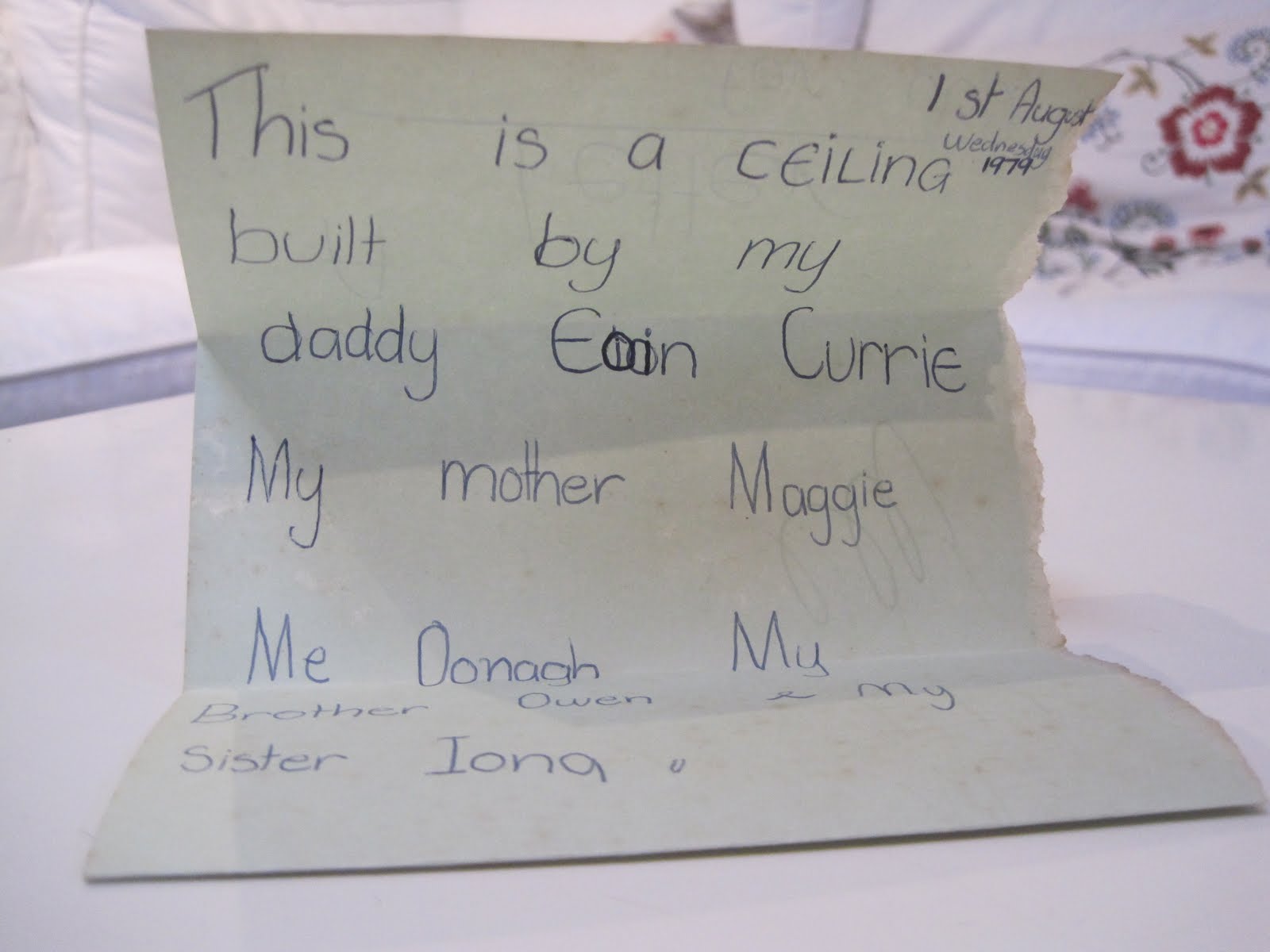
Last week, while rushing out the door to pick up kids’ from school Louis – in a way that only a two-year-old can – knocked a photo album out of the bookshelf. It was one I hadn’t looked at in years and it happened to fall open on a page of photos of us renovating our first flat. As I picked up the album I noticed a folded piece of paper shoved behind one of the pictures. ‘A letter for you’ it read on the front in childlike handwriting.

I’d forgotten all about this letter until now. We found it when pulling down a false ceiling in one of the two bedrooms. Our flat was built in the basement of a 1930s building, complete with high ceilings, archways and a lovely sandstone wall in the kitchen. But it had been renovated in the late 70s so down had gone slate floors in the hallway, bedroom and bathroom. And up had gone false pine ceilings in one of the bedrooms and kitchen.

A modern look of its time, I suppose, but we still found it hard to believe they covered up a plaster ceiling complete with a rose and cornices. Anyway, they did and thanks to the letter we also know they built the ceiling themselves, on Wednesday August 1st, 1979.

I don’t remember feeling bad about ripping down their handiwork. After all, it had lasted 20 years. I do remember feeling more connected to the home though. It was nice to think that a family had stood in this room, just as we were, working together to create a space they loved.

Friday, August 6, 2010

At Home with ... Children’s Illustrator Mandy Sutcliffe


A few months ago I was looking for a card for my cousin’s 40th birthday. She is one of those innately stylish people and I expected to find her a very sophisticated, ‘grown-up’ card. Then I saw a child’s birthday card illustrated by Belle and Boo creator Mandy Sutcliffe and I no longer wanted to be thinking like a grown-up.

The card was an illustration of a little girl with long brown hair sitting on a branch of an enormous tree. There was an expression captured in the little girl’s face: one of utter contentment, perhaps daydreaming of a future where anything is possible.


Instantly I saw my cousin as a child and our lives as an extended family. While we grew up in different cities, we would spend every second summer together when my aunt and uncle would bring my three cousins to Sydney to stay with our grandparents. Those were long days filled with playing on the beach and evenings spent in the house where my mother, my cousin’s mother and their two brothers grew up.

This illustration had managed to send me straight back to that time and childhood home. Indeed, all Mandy’s illustrations carry a similar power as she expertly captures simple moments in time and the emotions of childhood. How does she do it?

Mandy Sutcliffe studied Illustration at Leeds Metropolitan University but it was during a university exchange trip to France that she discovered a passion for capturing such moments of childhood.

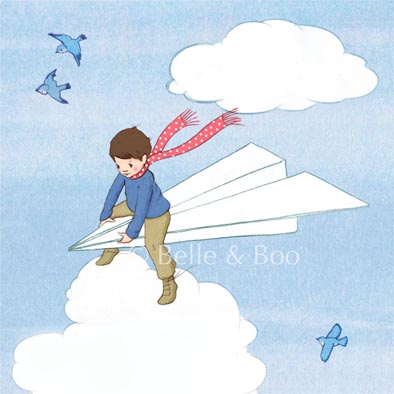
‘Aesthetically children are really pleasing to me: the bigger head, masses of hair, huge eyes, small nose, rose bud mouths, turned in toes, skinny arms and legs and rounded belly, what could be cuter to draw? I also like the freedom that drawing children gives you. A little boy in a paper boat or riding a winter woolly is more acceptable to the viewer than if an adult was doing it, as it ties in with the imagination of a child.’


As a child, Mandy’s imagination was captured by the book Milly Molly Mandy. ‘This was the book I was read most as a child. I was given it because of the name and weirdly I did look a lot like her. I wonder now if I liked it so much because Milly Molly Mandy was an only child and had the full attention from her extended family of adults; parents, aunts, uncles and grandparents. My little sister arrived when I was three-years-old which must be a shock for all first-borns!’


But it was also the sense of adventure closely tied to the security of home that Mandy remembers, ‘I loved the map printed at the beginning of the book as I could see where she was at all times during the stories. For Milly Molly Mandy to be able to go camping or into the woods on a big adventure and for me to see from the map that it was just next door to her home or the village shop was reassuring.’


Mandy grew up with a similar sense of freedom and it was also these childhood experiences that have informed her work. ‘Friends of ours had a house with a huge plot of land, with a wood, a field, a pond with an island, a pool, a river running through it with a beach and a bridge and, and, and... I am sure if I went back it would seem much smaller, but I remember endless summers of playing made-up games with lots of kids of all ages. We felt free, creative and alive, but very aware our parents were nearby in an emergency.’

The illustrations in Milly Molly Mandy spoke so strongly to Mandy that she now hopes to recreate those same emotions for children looking at her own work. ‘Of course the illustrations were a HUGE factor in my enjoyment. I still think they are stunning and constantly look at them for reference. In one of my books I have coloured them in with felt tip pen. I wish I could remember how I felt when I was doing it: did I know I wasn't meant to but had an overwhelming feeling that I must? Or was it just complete happiness in the moment?’

‘I am about to launch the first Belle and Boo activity book, which is designed for kids to colour in. I have spent ages on the line drawings and it is printed on good quality paper as I think children appreciate quality as much as adults.’ (For those of us in Australia, thankfully this book as well as all other Belle and Boo products, are available through Lark)


Mandy’s children exist in an era long gone but it’s an era that symbolises for her much about the magic of childhood. ‘I want to capture the sense of family and simplicity, quietness and nature rather than all the technological rush and business of today.’ She hopes that for children and adults the illustrations evoke feelings of innocence, happiness, safety, escapism and beauty in the minutia.


Inspired by the toys children played with the blurred photos that exist of that time, Mandy also loves capturing ‘the big floppy hair bows, the wrinkled down ankle socks, shorts for boys, dresses always for girls, the colours, the material and the hair styles.’


Such real people to her, Mandy says ‘you will often hear me talking to one of my illustrated children when I have got them just right, saying "ooohhh you are so cute" or "I love your shoes".’

It’s unsurprising then that the physical space Mandy first considers home is her studio. ‘We had it built three years ago in our back garden and it is wonderful to have a place to work & even more wonderful to be able to lock the door and leave it behind. I used to work in the lounge room, so I never switched off. My flat is now lovely and calm and tidy, my studio on the other hand is always in a huge mess!’


But first and foremost, home for Mandy is being with Russ, her partner of 16 years. ‘He makes any place home: we have travelled, house swapped, rented and moved a lot, and all I need is him and a few good friends. A great art shop, book shop and cafe nearby also help!’


To find out more about Belle and Boo, visit
their website
If you are in Australia and wish to see more Belle and Boo products, visit
Lark
If you would like to visit Mandy's blog,
click here
All photos © Mandy Sutcliffe

Wednesday, June 23, 2010

When Home is... Food Memories


I have been thinking a lot about food recently and the comfort a home-cooked meal brings. Maybe it’s because we’re in the middle of Winter when comfort meals (like the Shepherds’ Pie I’m in the middle of preparing for dinner tonight) always conjure strong memories of feeling safe, warm and secure.

Maybe it’s also because I’m writing up my interview with Natalie and Simon Thomas, owners of The Sydney Picnic Company, which will be all about how food makes a ‘home’.

Whatever the reasons, I thought now would be a good time to start thinking about the relationship between food and home. Last year I wrote an article that was published on the parenting website Sunny Days. It’s all about my food memories, recipes written on bits of paper, backs of envelopes and shoved inside a recipe journal...

Scraps of the Past
(first published on Sunny Days, 1st July 2009)

'It’s the making-food-book!' says my son excitedly as I search through the multifarious scraps of paper that live inside this book to find our banana bread recipe one recent Sunday afternoon.

I bought this blank-paged journal soon after I left home when I realised I didn't know how to cook spaghetti bolognaise, tuna mornay or whatever other childhood comfort dishes a 21-year-old thinks she needs to know. I had planned to write all the recipes in it, just as my mother had done and continued to do throughout my life. But after neatly writing a few, the book remains blank and unopened. The spine threatens to break though; it has begun to tear thanks to all the loose paper recipes I 'one day' meant to transcribe but instead are just shoved inside.

My husband walks into the kitchen as I begin to sift. 'I don't know how you can find anything in there.' He adds as he passes, 'We don't even use half those recipes.'

And, as I stare at the mountain of paper in front of me I realise he's right. There are recipes I cut out of magazines five years ago and have never attempted. But now is not the time for a cull. My son has already pulled a chair over to the kitchen bench and is on his way to collect eggs from the fridge. Not the safest job for a three-year-old. It hadn't taken long to find the banana bread recipe anyway. I know the scrap of paper it's on -- my father's old company's letterhead -- and it’s heavily stained with coffee cup rings and traces of, perhaps, egg? As I grab the beaters I wonder why I never bothered transcribing this. Five ingredients and three steps is hardly many words, yet it's been sitting on that piece of paper, inside that book for years.

Once the banana bread is in the oven I decide to declutter. One more recipe could be the metaphorical straw. So it begins: the Coconut and Raspberry Bread torn from a magazine, dated a few months after my daughter's birth nearly six years ago. The same recipe I used for the morning tea after her Naming Ceremony. Instantly I'm back in our first marital home, the sun streaming through the window as I baked. I don't want to throw that memory away.

Moving on, there's a lemon syrup cake recipe which I remember taking on a weekend trip to the country when I was eight months pregnant. We weren't near any shops and had to bring all the food. Next to the list of ingredients are little ticks made by my husband's hand. Obviously it was his job to pack the food. We ate that cake drinking cups of tea while watching the cows and ducks as we contemplated life with a baby. Another memory, another scrap of paper kept.

An old printed email appears from a time before children; a risoni recipe a friend had sent me -- at 10am -- that apparently I wanted to cook that night. Obviously it was a slow work day. It's strange to see the sign-off with my position and company details: another life. Both of us are now home with children and it's not long before I find a handwritten note from that same friend for a kids’ version of chicken casserole. No longer does she end her recipes with 'serve with a full-bodied red'; now it's 'add some chilli and it becomes an adult dinner'.

Some shiny paper unfolds and I realise it's fax paper -- a faxed recipe! -- with writing so faded some letters no longer exist. I notice the measurements are in pounds and ounces. It's the apple crumble recipe from my oldest school friend. Her British mother used to make it for us frequently when we were kids and when this friend's grandmother died she was given the Wedgewood dish her grandmother used to bake this crumble. I've always known it by heart and think of her family whenever I make it. I can't bear to throw out the memory of using our parents' fax machines to communicate when we were 14. Also, how many recipes end with 'Put in a bowl and eat with spoon’?

There’s the 'San Choy Bau' recipe I secretly tore from an office magazine, now crinkled at the edges. I fondly remember this ‘phase’: my husband and I were living together and this recipe became the 'dinner party' one. What could be better than friends, a bowl piled high with iceberg lettuce leaves and a few bottles of chardy? Oh, the mess. The lettuce breaking, the sauce running down chins... the carpet... but who cares when you're 23? Actually, if we cooked this now for our three children it would be a similar experience. Best kept; those were good times.

A green note sticks out. It's the mussels in white wine recipe from an aunt. She and my uncle invited us over for dinner to celebrate our engagement. Afterwards, she wrote the recipe while washing up. It's still water-stained from a stray soap sud. A few years later they divorced and my aunt cut off contact with his family, including me. I was very fond of this aunt and now, with the benefit of age, I can understand her inability to stay involved with his extended family. I don't want to erase the last evidence of her in my life though. Another scrap to keep.

A recipe that has made it inside the book is 'Tim's flourless chocolate cake', written by Tim himself. I remember the night we ate this. He was going out with one of my closest friends and it was perhaps only the second time we met. Each couple brought a course and theirs was obviously dessert. They were late. 'It's my fault,' he began, 'I got stuck at work and got home to discover I was out of flour.' I looked at the flan tin he was holding with the very flat cake. 'But it's ok, it doesn’t need it.' And very quickly, after a few bottles of red, it became Tim's signature dish. He wrote the recipe down late that night and I wondered if years later I would even know this Tim of 'Tim's flourless chocolate cake' fame. As the oven timer goes off and I pull the banana bread out, I question how I didn’t realise he would go on to marry my friend and later become godfather of our youngest son.

Now, looking at the pile mounting in front of me I decide to stuff all these pieces of our past back inside the heaving covers. These scraps are the keepers' of our family's story; I realise this book is one of the most important objects in our house. My husband's trash is my treasure it would seem.

Later, my mother tells me about an old lady who didn't survive the recent catastrophic bushfires in Victoria. She was found in her car and next to her was a complete china dinnerset. The image haunts me. Imagine the tales those plates, soup bowls, cups and saucers would have to tell. What precious memories did they trigger which made the thought of losing that china unbearable for her?

I don't want to throw away my memory triggers. One day when the children are older I will share these stories about how those recipes have shaped our family and later it will be up to them to decide if those scraps of paper are ready to be binned.

LinkWithin

Related Posts with Thumbnails