Showing posts with label 1950s. Show all posts

Monday, January 10, 2011

When Home is... a book inscription


“To Sybil & Geoff,
With best wishes for future happiness.
From Tom & Claire”

I’ve been thinking a lot about Sybil & Geoff as well as Tom & Claire for the last couple of months. It’s a bit odd really as I don’t know either couple at all.

All I do know is that Tom & Claire gave Sybil & Geoff a 1954 edition of the book The American woman’s new encyclopedia of home decorating and somehow it turned up in my sister’s vintage store Retrospections. My sister sells a lot of second hand books, but most don’t have inscriptions inside. If only all second-hand books did have inscriptions though. I doubt I’d ever buy a new book again.

Today, what would be a funny read about being a 1950s housewife is so much more with that inscription inside. Who were Sybil and Geoff? Was this an engagement or wedding present? How did Sybil feel about being given a book about home decorating? And poor Geoff. I can’t imagine that was an exciting present for him back in 1954. Or 2011 either.

Fifty-six years have passed since Tom and Claire bought that book. Did it sit on Sybil and Geoff’s bookshelves for the duration of a long marriage or a very short one? Who made the decision to give it away? Perhaps they are no longer here and all their books were boxed up and given away by one of their children. I wonder if their marriage even produced children.

Did they emigrate to Australia? I’m guessing they were American given the title of the book. I think the Australian women of the 1950s had their own home decorating guides. Or perhaps the book was found at an American market long ago and brought to Australia by another owner...

And as for Tom and Claire, were they close friends of Sybil and Geoff? I do find it interesting that Claire has written Sybil’s name first while signing her own after her husband’s. I’m guessing they were already married and that Tom definitely didn’t go shopping for Sybil and Geoff’s present, let alone write the inscription.

Perhaps they weren't that close - Claire's signoff is a bit cold really. Not 'love' or even 'best wishes'. 'From' is close to 'Yours sincerely'. Perhaps Tom and Geoff were work colleagues and the wives didn't really know each other? Or perhaps Claire was just a tad formal and thought Sybil's house could do with an injection of style.

It’s a mystery and I’ve never even read the book. Unfortunately my sister sold it quite quickly. I’m guessing Sybil & Geoff and Tom & Claire had a lot to do with its appeal. And I hope for their sake it has ended up in a happy home.

Monday, August 16, 2010

When Home is... a Workshop


‘A workshop is the foundation for home improvements’, a March 1956 copy of Australian House & Garden tells me. Yes, it’s the same magazine that talked about expanding living areas into garage spaces and such articles make me realise that back in the 50s it would have been hard to get a job as a handyman. It seems that DIY really did stand for ‘Do-It-Yourself’ back then.

And it feels like everyone would have had the skills – and the workshop – to refurbish the bathroom, make a fireplace surround, build their own back fence and chairs (!) all in the same month.

But the DIY project that stood out for me the most in this issue was step-by-step instructions for making your own cocktail table:

‘Want to make your own cocktail table quickly and easily? Here’s one you’ll have little trouble with, modern as tomorrow, very inexpensive and fitted with a tricky feature you’ll like – a top that is automatically self-dusting. Crumbs and dust will drop right through for the sweeper to pick up below.’

I like the idea of regular cocktail parties at friends’ homes. It seems very glamorous and grown up yet I don’t know anyone who entertains this way anymore. Amongst our friends, brunch is as adventurous as we seem to get at this stage of our lives.

Anyway, back to DIY. The instruction that stood out for me was: ‘To attach the table to the brass legs, your husband can drill holes through the brass rod for thin screws.’

Obviously husbands took care of DIY AND the use of any power tool back then. If my husband and I existed together in the 1950s, our house would be falling down around us. While my husband is fantastic in many ways, one of those ways is certainly not while holding a power tool.

He cooks, cleans, shops for groceries and gets up to the children in the middle of the night but when it comes to DIY we’ve had some disasters. Most notably, a very crooked towel rail in the bathroom which seems to be sloping more as time goes on.

Yes, he can put Ikea furniture together but I don’t fancy his chances with the cocktail table. Perhaps it all comes down to the state of our back shed. Today, it’s certainly not any ‘foundation for home improvements’ and definitely not with all those cobwebs growing across the doorway.


B&W picture taken from Australian House and Garden magazine, March 1956

Friday, August 13, 2010

When Home is... an Object


Is there any one object in your home that encapsulates all the emotions of home for you? For me it would perhaps be my collection of old silver cutlery, which I slowly bought during a number of trips to the UK when I was in my 20s.

I remember walking into those antique shops in tiny little villages and feeling so excited matching up odd bits of cutlery for my future home. I imagined my future children using the cutlery and knowing its history; knowing I lugged it home at the bottom of my suitcase all those years ago from the other side of the world; knowing it was now part of our family story.

I often think of an old lady who died during the Victorian bushfires of 2009. She was found in her car with a full china dinner set beside her. What memories did those plates, bowls, cups and saucers hold for her? Perhaps it was her wedding china; or her mother’s? Imagine all the meals eaten off them. Christmases, birthdays, anniversaries... the precious conversations, intimacies, maybe even arguments that those plates may have been privy to?

The power to attach emotions to objects is very strong and this is also one of the reasons why my sister wanted to open a shop which sells, amongst other things, vintage and retro objects.

She says, ‘What I really feel like I am doing is giving objects from the past with their own stories and histories the chance for a new life with a new "custodian" for want of a better word. These pieces all have something appealing about them - be it their colour, shape, function ... or quirkiness. And when someone sees something they just love and have to have that makes it all worthwhile.’

Justine’s customers may already be collectors: ‘I have a lady who comes in only to buy coloured glass and she just keeps on adding to her collection: sundae dishes, wines glasses. It's the colour and the design of them when all combined together that she loves.’


Or they may have just started collecting: ‘Another customer owns almost as many ramekins as I do now (and she owned none before!). I'm pleased to see I am not the only one who is obsessed with the most practical invention in the world: everyone needs a ramekin...or 50.’


And have now become passionate about it: ‘An older man comes in regularly to buy different pairs of vintage champagne glasses; he likes that his collection is made up of numerous different pairs. He told me he has never collected before but is now addicted to it and he looks forward to family celebrations so he can pull them all out and tell everyone the story.’


But there are also those special stories of customer’s looking for a very specific object:

‘A woman once came in to buy the exact 1950s mixing bowl - colour, shape and brand - that she and her grandmother would make cakes in together when she was young. It was the only thing she wanted to keep after her grandmother died but it was broken in the cleanout of her home. She had been searching for years and she found it here. I don't think I have ever seen someone so ecstatic to buy a yellow & white polka dot mixing bowl.’


‘One lovely lady, who has always popped in since I opened the doors 12 months ago, asked me to keep my eye out for a 1950s set of MacArthur Splayds - just like the set she was given as a wedding present but had since lost after numerous moves and life changes. I did search and of course she checked in every week to see if I had found any. For months I couldn't; it was like they were hiding!’


‘Then one day I did and that morning I was so excited to call and let her know. Literally as I picked up the phone she walked in the door! She was so elated about them and the timing she went straight across the road and bought a lottery ticket for us to share. We didn't win anything but that's not the point. It was just one of those moments you couldn't make up.’

Of course, there doesn’t need to be a significant history or price attached to an object to create strong emotions: ‘A customer who works nearby is addicted to the handmade felt flowers I stock so every few weeks she pops in and adds another to her collection. She says they just make her happy.’


When I think of the favourite objects – new and old – in my home they all have one thing in common. They make me happy too.


Retrospections is open Tuesday – Friday 10am-5pm; Saturday 9am – 3pm
498a Miller St
Cammeray
Sydney


Photos © Justine Joffe

Wednesday, August 4, 2010

When Home is all about Living Spaces... or lack of them


Like so many families with growing children, we’re renovating to get more living space. It’s ironic, isn’t it. When you have toddlers and preschoolers, all you want is an open plan house. In fact one HUGE room would be plenty. No doors to squash little fingers, no stairs to fall down, a view from the kitchen or laundry (where parents of young children seem to spend an obscene amount of time) to all corners of the house, including the garden.

But now it’s getting busy and chaotic in our kitchen / family / dining room. Particularly in Winter when I can’t open the back doors and send everyone outside. And when we have friends and their families around... let’s just say it’s very loud in here.

Recently I was flicking through my sister’s collection of 1950s home magazines and laughed. So many articles were about how to create more living spaces for growing families. Yes, nothing much has changed. In particular, one titled The Garage gets Playroom Gaiety from a March 1956 copy of Australian House and Garden caught my eye:

‘If you like entertaining – and particularly if you have young folk in your family – you need an all-purpose room. Like this garage-through-to-living-room shown here. Come any party night, the car goes out, overhead door from living room has a colourful canopy tacked over it, and in go the bridge tables and chairs ready for the card game. When teenagers take over for dancing, there is still plenty of room for adults to lounge.’
We don’t have a garage, I don’t know anyone living in inner-city Sydney who does, but I liked the sentiment behind the idea. Here was a way to get more space that didn’t involve sending children to one end of the house and adults to another; a way of continuing to socialise together. Mind you, I don’t know about the dancing and card games. Being a ‘lounger’ myself, I definitely relate more to the need for ‘plenty of room for adults to lounge’.

Monday, June 28, 2010

Home from the beach without shells


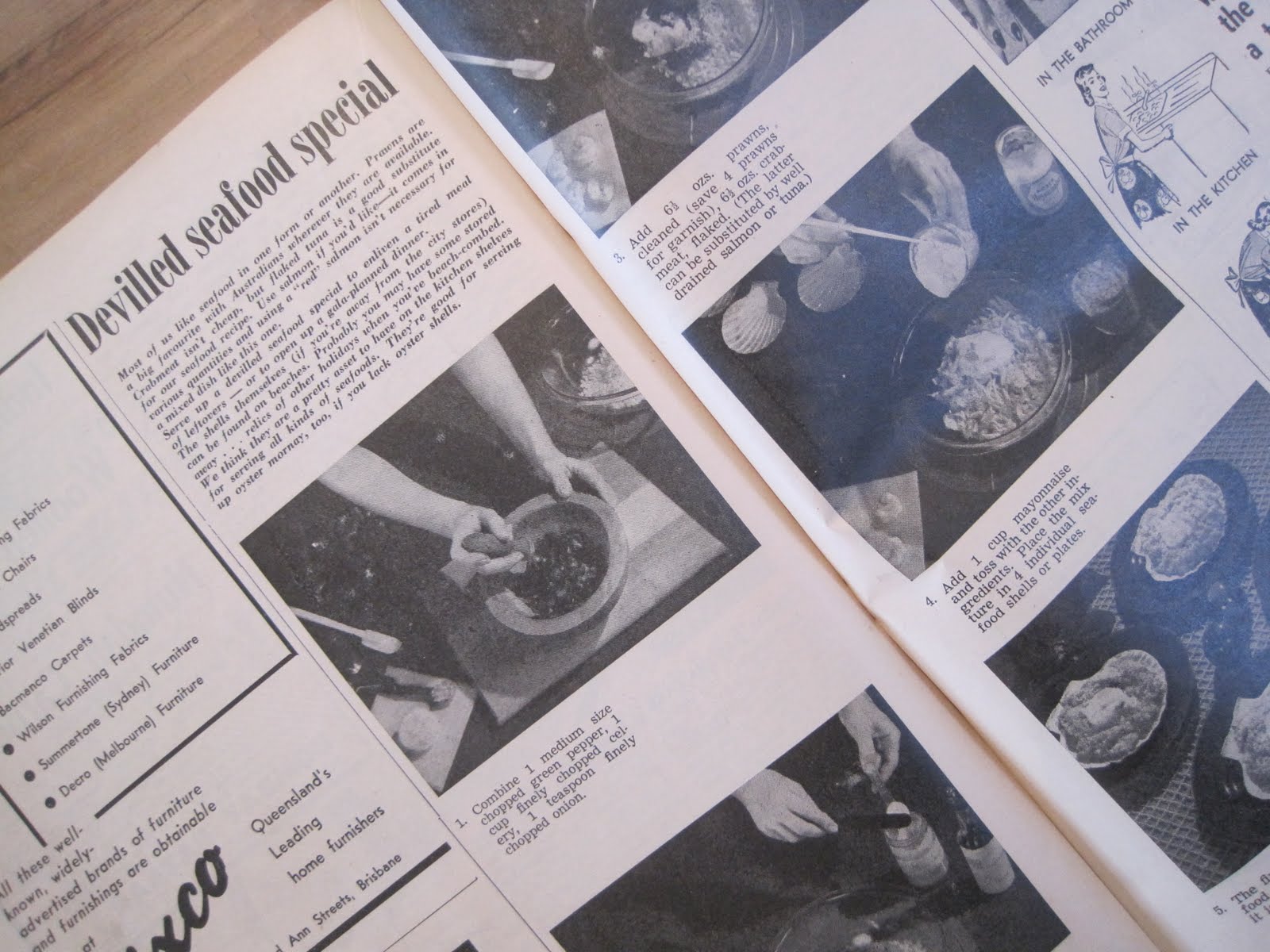
We’ve just returned home after a long weekend away at the beach. After unpacking sandy clothes from bags straight into the washing machine, the next thing to do is decide what to cook for dinner. Something that doesn’t involve any fresh ingredients so I can put off visiting the supermarket until tomorrow. While staring into the pantry, I suddenly think about a recipe I read in my sister’s 1950s copy of Australian House and Garden magazine.

It’s for a ‘Devilled Seafood Special’. I’m not even sure what devilled seafood is but apparently it can ‘enliven a tired meal or leftovers’. What reminds me of this recipe today is the magazine’s suggestion of presenting the food in seashells: ‘The shells themselves can be found on beaches. Probably you may have some stored away...relics of other holidays when you’ve beach-combed.’


Well, we beach-combed and didn’t find any shells at all. Perhaps some tiny ones, but certainly none large enough to serve up a meal. And this was on a large and very deserted beach. My four-year-old was also insistent that no one touch the shells once we did see some as ‘you need to leave them for the hermit crabs or they won’t have a home’. He became quite distraught at the thought of little crabs searching all night long without a home to call their own.


This anxiety was thanks to a ‘travelling aquarium’ that came to his preschool a few months ago. The children were allowed to look at starfish, feel seaweed and see other marine life living in rock pools. They were also told to never collect shells on the beach, or if they had to, to only take one or two as otherwise there would soon be none left.

At the time I thought this sounded ridiculous. Yet another fun, outdoorsy, technology-free pastime of childhood was no longer ‘allowed’. I loved having a shell collection when I was younger; looking at them and remembering which beach I collected them from. What was the harm?

But, after this weekend, I wonder if maybe it was true. Are we running out of shells? Where have these dinner-plate size clam shells gone anyway?

So, here I am without shells — those ‘pretty assets to have on the kitchen shelves for serving all kinds of seafoods’ – but for tonight at least I have found a tin of tomatoes and a packet of penne.

Sunday, June 6, 2010

When Home is...a 1950s Dinner Party


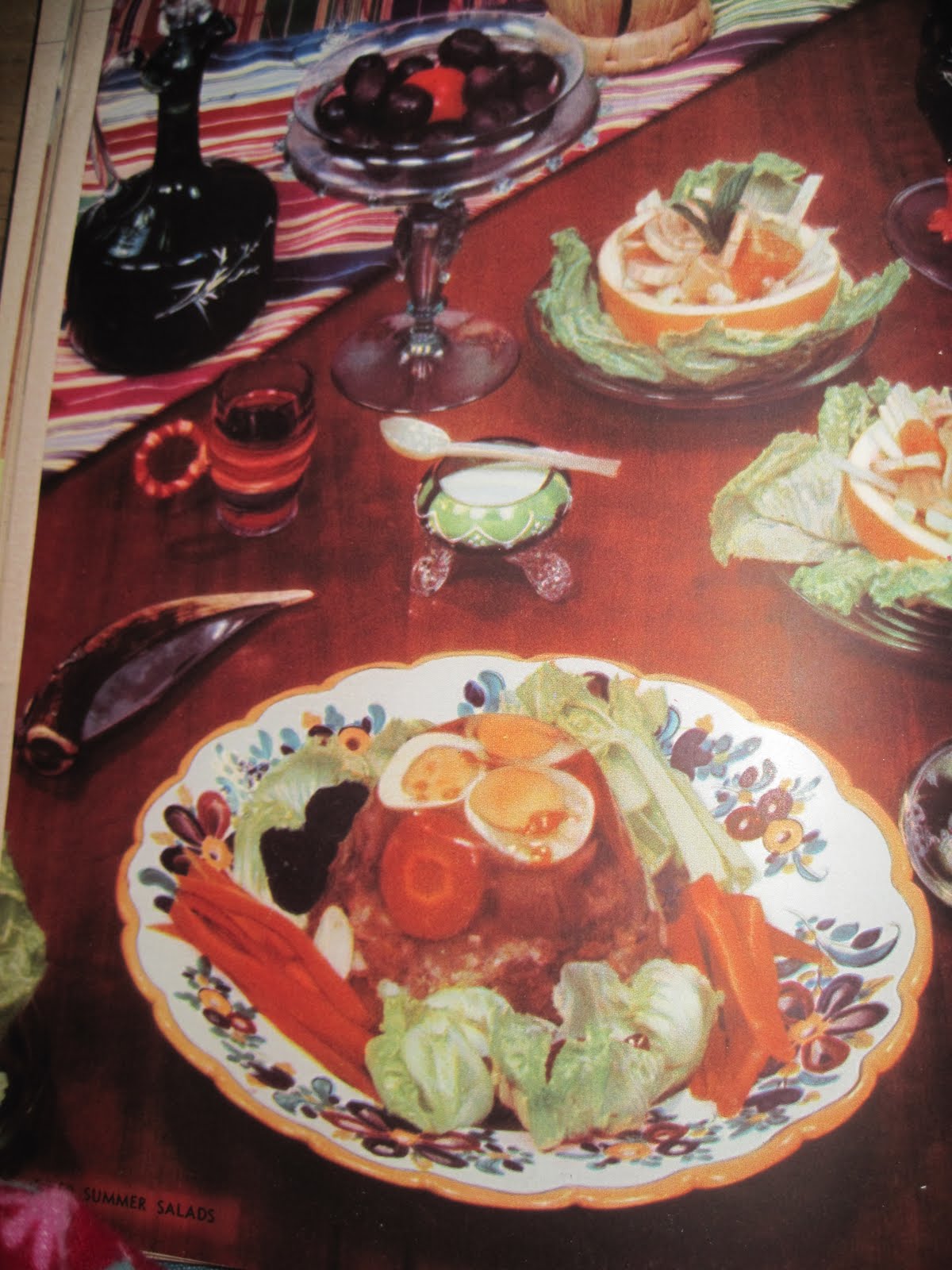
It’s Saturday night. The children are asleep and dinner is finished. I am on the lounge enjoying another glass of wine while I read a book published during the 1950s. It’s titled the Australian Woman’s Complete Household Guide Illustrated. My husband is watching rugby and washing up. He cooked dinner too, as he often does. The scene in my home tonight does not echo the 1950s Home Entertainment scene I’m reading about.

Let’s play a game and pretend it’s a Saturday night in June 1956. After all, ‘a wise hostess will organise games in which all may join’ and such a game may make this blog post ‘go with a swing’. We’re having an informal dinner party, although I realise there are still ‘rules of etiquette to be followed in setting and arranging the dining table’.

We’re having dinner for eight. I will use a linen tablecloth as they are now more popular and I can’t use place mats as my table is most definitely not in ‘almost perfect condition’. (Didn’t children use textas in the 1950s?!) I will allow my place settings to be spaced so that my guests have sufficient elbow room and the base of my cutlery handles will be a ‘straight line one inch from the edge of the table’. The napkins will be folded in the ‘customary rectangular shape and placed at the left of the dinner forks with the fold outside’ and I will have a small vase of jonquils in the middle of the table, as flowers ‘are still and probably always will be the most suitable decoration for the centrepiece on the table’.


Because I want to be a good hostess, I will plan the seating arrangements beforehand. My husband and I will be at opposite ends of the table and we will separate married couples and seat the opposite sex alternately. Being the mid-1950s, the number of courses presented at dinner parties is ‘now very elastic’ and as my food will be ‘well chosen, beautifully cooked and presented’ I am apparently able to be as free as I like in the choice of dishes.


After our black coffee in demi-tasse and liqueurs are served at the table, a tray of drinks – whisky, gin, beer or soft drinks – will be brought into the living room before our guests leave.

BUT WAIT

As we don’t have a separate living room or dining room perhaps we shouldn’t be having this dinner party after all. I should have organised a buffet dinner party instead. All we will need to do is remove all the chairs and leave our dining table in the middle of the room. As a ‘buffet meal is mostly informal, the tablecloth can be gay and interestingly patterned and the centrepiece can be made up of flowers or fruit’. There are ‘no fixed rules for setting the table for a buffet party’ and ‘it needs comparatively little preparation’. It will be a much shorter evening too – 5pm – 7pm – ‘excellent for a hostess with many social commitments’. The only other preparation we will need to do is ‘fill all the cigarette boxes and see that there are matches and large ashtrays on occasional tables’.


Seems like it will be relaxed and fun evening, don’t you think? Well, perhaps not for me. I’ll still be busy working. At a buffet party food and drink will be the least of my worries. Once my guests arrive I’ll introduce them to each other and ‘put them at ease’. If there are a couple of late-comers, as always, I’ll have to ‘lead them to one group or another and see them established so that they will not feel embarrassed or ill at ease’. But what will happen if a ‘certain amount of group forming in corners grows into a number of impregnable private conversations’? A good hostess will not let this happen. This is a shame as I wouldn’t mind being a part of a few ‘impregnable private conversations’. However, because I am a good hostess I will ‘apparently casually drift into different groups in turn, drawing some together and breaking up others’.

Well, I hope everyone else had fun because I don’t know that I did. Our guests will leave, piling out our front door, gaily laughing and swapping phone numbers with one another and I imagine I will be exhausted. Hearing them say what a ‘wonderful hostess’ I am as they climb into their cars should be enough for me to want to entertain every Saturday night. After all, ‘to describe a woman as a wonderful hostess is the highest compliment that can be paid, for it means that the person so described has the capacity for taking pains; that she has tact and charm and a genuine interest in other people. The art of entertaining needs practice, and involves a great deal of hard work’.

Back here in 2010, with three children aged under six, I know myself too well and should have paid heed to the warning at the beginning of the Home Entertainment chapter: ‘She should never undertake more than she can accomplish with ease as the pleasure of guests will be spoiled if the hostess appears to be tired’. My wine is now finished and I head off to bed with renewed appreciation and wistfulness for a conversation with my Nanna. I don’t know how she, as a mother of four, managed it back then.


I’d love to hear some real-life 1950s entertaining stories. Please leave me a comment if you have any.

*All photos are taken from the Australian Women's Complete Household Guide Illustrated. Colorgravure Publications (The Herald and Weekly Times Ltd)

LinkWithin

Related Posts with Thumbnails