Showing posts with label Sydney. Show all posts

Monday, July 4, 2011

When Home is... Living with Environmentally-Friendly Solutions


When Paula Cowan first started buying the Solution Living brand (environmentally-friendly household, personal care and baby products) four years ago, it wasn’t just about helping the environment.

‘I did like the fact I was buying an environmentally-friendly choice that worked, but more than that I liked the way the products looked and smelled!’


After her daughter arrived nearly two years ago, Paula realised how much more waste you can easily create having children and began to think of ways to reduce, recycle and reuse at home. Combined with the opportunity to buy the Solution Living business in December last year, she was forced to clarify even further her thoughts about consumerism.

‘Owning the business has made me research more environmentally-friendly ways to live and question the choices I make. What really are the benefits of using these household products? I needed to understand the science behind it which has led to a re-education.’


This re-education has also led to learning more about the manufacture of products before we even buy them.

‘I like to think of it as upstream and downstream,’ says Paula, ‘We’re all well-educated to what happens downstream; we know what certain chemicals do to our skin and we know how to recycle plastic and paper packaging, as well as the consequences of washing these products down the sink.’

‘Slowly we’re becoming better educated on what happens upstream: what actually goes into our products. We already understand more about what really happens to our food before we eat it and now we are learning about what goes into our laundry, dishwashing, cleaning and personal care products.’

What goes into the Solution Living products are plant extracts and renewable sources so the overall impact on the planet is small in manufacture, use and disposal.

Today, Paula thinks we are all on a path of understanding our environmental impact and is always interested in listening to the range of understanding her customers have. Some have specific reasons for wanting to buy the products – perhaps they have sensitive skin or have a family member with allergies – while other customers are actively looking for as many environmentally-friendly alternatives as they can find.

In her own house, aside from using any environmentally-friendly alternative for cleaning, personal hygiene and nappies, she and her husband have also made the choice to buy a diesel car. They compost and recycle and plan to get solar panels and a water tank installed.


They have recently moved to a larger fixer-upper house and these changes will all be made slowly. As Paula says, ‘trying to live completely environmentally-friendly is overwhelming whereas incremental changes are more sustainable.’

Paula and I both grew up during a time when environmentally-friendly products were expensive, didn’t work as well or smell as good. Recycling was only just starting to be considered important and I don’t even remember the word ‘organic’ being used in relation to food or cotton or anything.

Today our children are growing up with separate bins for waste, paper and glass at home as well as in their parks and other public spaces. They know which food scraps go into the compost bin and despite living in the middle of a city understand the concepts of worm farms and vege patches.

But, unlike Paula, I hadn’t really become a conscious consumer when it came to household products. Ned and I recently visited her Solution Living stall at Sunday’s Frenchs Forest Organic Market and he spotted the bubble bath. At home we were still using Johnson & Johnson soap free and I hadn’t really thought about changing over.


Ned insisted we try the lavender bubble bath and that night the kids enjoyed more bubbles from one squirt than I would have thought possible. They were happy, clean and smelled good too.

The J&J bottle still sits half full on the side of the bath because every night the children ask for the ‘really bubbly bubble bath’. No wonder it is Paula’s biggest seller.

Yes, incremental changes are happening in this house too... one bottle of bubble bath at a time.

For more information about Solution Living, visit the website here.

To read about how Paula and her family live in an environmentally-friendly way at home, visit her blog
here.

All photos © Paula Cowan

Thursday, March 31, 2011

When Home is... your Grandmother’s Kitchen. An interview with authors Laura Clarke & Claire Wallace


With Mother’s Day just around the corner many of us will be planning to spend time with our families; sharing a meal with our mothers at some point that weekend. But really, how often do we talk to our mothers – and if we’re lucky enough our grandmothers – about their lives and our families stories?

There may well be a favourite family dessert we have been enjoying all our lives but how many of us know the origins of that recipe? Why our mothers or grandmothers used to cook it, who gave the recipe to them and why it has become such a family favourite? We may never think of how these stories began. It’s just a fact that this is our family’s cheesecake recipe; or our family always glazes a ham at Christmas time.

Usually by the time we reach an age when we want to know more; when we’d appreciate the wisdom and seek the comfort of the older generation, our grandmothers aren’t here anymore to give it. It was this realisation that gave Laura Clarke and Claire Wallace the inspiration to record grandmothers stories from around the world. The result is the just published, beautiful recipe book My Grandmother’s Kitchen

.

Both women had recently met and both were at turning points in their lives when the conversation about this joint project began: ‘My grandparents brought me up’, says Laura who lived with them in England from the age of 11. ‘When my grandmother died she left me three things: her engagement ring which I wear every day, her kitchen table which we used on the cover of our book, and her recipe book filled with her handwritten sheets of recipes.’

'A couple of years ago, after my grandfather died, I missed them both horribly. I realised I was working in a job I wasn’t passionate about and thought what am I doing? They didn’t raise me to be unhappy so I quit my job and thought about collating my grandmother’s recipes during my time off work.’


‘It was around this time that we met,’ continues Claire, ‘My grandmother had died many years before Laura’s, when I was only 19. Laura and I were talking about our grandmothers and their cooking and I realised I didn’t have any of her recipes written down at all.’

The conversation moved on from their cooking to a desire for both women to talk to their grandmothers again; to ask their advice about all aspects of their lives. ‘It felt like we realised too late how much they had to teach us,’ says Claire.

‘They had lived such amazing lives already and we have so much to learn from them. I remember my grandmother saying just before she died that she still felt 19 and that it was only when she looked in the mirror she realised differently.’

The concept from the beginning was always to include other grandmothers in their book. ‘It was never to be just about our own grandmothers,’ says Laura, ‘We were both passionate about the importance of grandmothers in the home and how great an influence they can be.’


‘So much importance is placed on youth in today’s world and I remember my grandmother saying to me in her 80s that sometimes she felt invisible. We were inspired to find everyday grandmothers for the book who were inspirational because of the lives they have led bringing up their families.’

This book was always going to be much more than just a collection of recipes from around the world. ‘We wanted to fill the book with the kind of information we knew we’d want from our grandmothers if we’d had more time with them,’ begins Laura, ‘we wanted to share these women’s life stories, we wanted them to pass on their wisdom.’


Both women interviewed the 17 grandmothers and their families for up to four or five hours each. They spent numerous hours cooking with them, spending time with their children and grandchildren, calling them constantly to ask more questions and in all cases Claire and Laura cannot emphasise enough how welcomed they were into each household.

It was a hugely emotional journey for them. ‘These women were so positive,’ says Claire, ‘despite some of the stories they shared. It was a reminder of all the things you don’t ever know are behind a face. You don’t know what anyone has been through and you certainly can’t judge their life journey by looking at someone’s face.’


The most emotional part of this journey for Claire and Laura was the death of one of their grandmothers, Cherie Keetley. Cherie died nearly a year ago and while she didn’t live to see the book’s publication, she loved being a part of its creation.

‘Cooking, like love, should be undertaken with wild abandon’, was a piece of wisdom Cherie shared and after her death her family were so grateful as they realised that without this book they would never have written Cherie’s story down. ‘Her recipes were completely embedded in her head’, laughs Laura.

‘I have notes and notes from cooking with Cherie,’ continues Claire, ‘as she had no idea about measurements cooking purely from instinct. Of course, we needed measurements to write the recipes so there was much laughter and trial and error!’

‘This project was so fulfilling,’ continues Laura, ‘we had no idea of the journey this would take us on and we realised again through Cherie’s death how important it is to capture your own families stories.’

The end result is a beautiful tribute to grandmothers everywhere with a chapter at the end to capture your own family’s story.

‘We wanted every page to be unique,’ says Claire, ‘we wanted it to look like a real grandmother’s recipe book with fingerprints, remarks and drawings by kids, splotches of jam.’

And intertwined within it all: those longed for comforting and inspirational words gained from years of perspective, endurance and experience.

No matter what your age who doesn’t need to be reminded that ‘things seem worse in the moment’ or ‘do not always think about your problems: you will see one day they are not so important’ and, finally, ‘Friends are like elevators. They either take you up or take you down. Hold on to good friends and let go of the rest.’

Recipes not only for food but for lives lived well.

************************

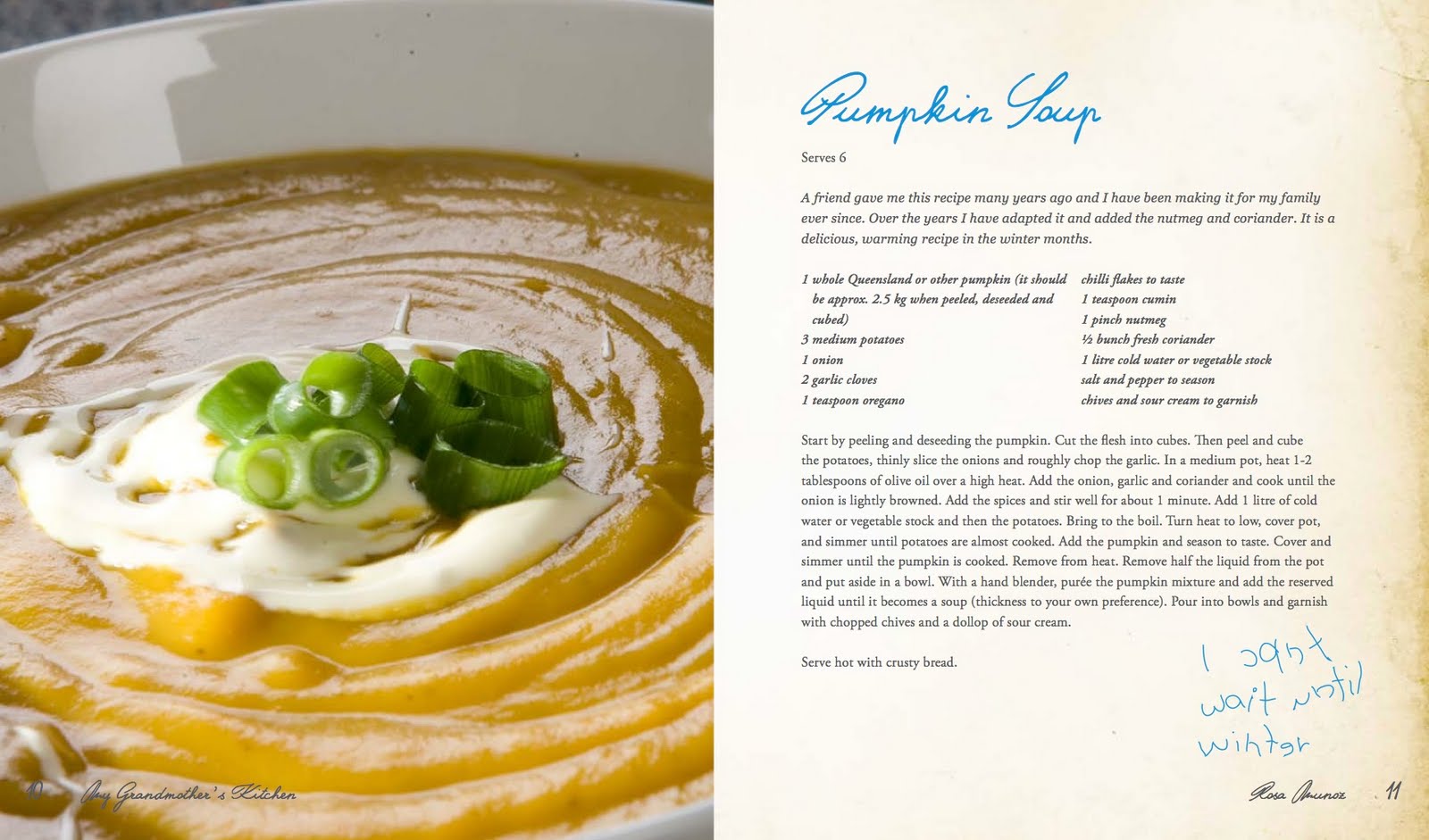
As the seasons in Sydney begin to turn and the weather is cooling down, Laura and Claire thought it would be fitting to share with us a wintry recipe from their book. And a drizzly, cool day like today is the perfect time to try it a warming pumpkin soup...

Rosa Munoz's Pumpkin Soup Serves 6
A friend gave me this recipe many years ago and I have been making it for my family ever since. Over the years I have adapted it and added the nutmeg and coriander. It is a delicious, warming recipe in the winter months.

Ingredients
1 whole Queensland or other pumpkin (it should be approx. 2.5 kg when peeled, deseeded and cubed)
3 medium potatoes
1 onion
2 garlic cloves
1 teaspoon oregano chilli flakes to taste
1 teaspoon cumin
1 pinch nutmeg
½ bunch fresh coriander
1 litre cold water or vegetable stock
salt and pepper to season
chives and sour cream to garnish

Start by peeling and deseeding the pumpkin. Cut the flesh into cubes. Then peel and cube the potatoes, thinly slice the onions and roughly chop the garlic. In a medium pot, heat 1-2 tablespoons of olive oil over a high heat. Add the onion, garlic and coriander and cook until the onion is lightly browned. Add the spices and stir well for about 1 minute. Add 1 litre of cold water or vegetable stock and then the potatoes. Bring to the boil. Turn heat to low, cover pot, and simmer until potatoes are almost cooked. Add the pumpkin and season to taste. Cover and simmer until the pumpkin is cooked. Remove from heat. Remove half the liquid from the pot and put aside in a bowl. With a hand blender, purée the pumpkin mixture and add the reserved liquid until it becomes a soup (thickness to your own preference). Pour into bowls and garnish with chopped chives and a dollop of sour cream.


For more information about Laura Clarke and Claire Wallace, or to buy a copy of the book visit http://www.mygrandmotherskitchen.net/

Their Facebook page also reports on the latest book news and gives you an opportunity to ask questions or contact Laura and Claire direct. Visit www.facebook.com/mygrandmotherskitchen

All photos © Laura Clarke and Claire Wallace

Monday, March 14, 2011

When Home once belonged to... a Bank Robber


Darcy Ezekiel Duggan was a bank robber and according to the Sydney Morning Herald, New South Wales’ most notorious prison escape artist.

In 1946, he escaped from a prison tram by cutting a hole through the roof with a kitchen knife and climbing out. Today that tram is on display at the Sydney Tramway Museum. Wikipedia details another time when he reportedly escaped from prison, leaving a note on the wall of his cell which read “Gone to Gowings”. He spent 30 years in prison; half his life.

For the other half spent outside of prison, he had to live somewhere. And for some time he lived in a terrace house in Sydney’s inner west; a terrace house that eventually belonged to friends of mine.

While restoring the old house, they discovered more stories of the home’s past. During a visit to the local demolition yard looking for windows, my friend met a man who used to live in her street and ‘run the best two-up game in Sydney’ in the backyard. Another time her husband saw a family sitting in a car outside the house staring in. The father explained how it was once a boarding house and his whole family lived in one room. He wanted his children to see that not everyone grows up in a big house.

A house with a colourful past and colourful characters; but were there any signs of Darcy Duggan’s occupation? Perhaps. A loose brick in the kitchen wall was always a curiosity. A brick my friends spent many years not moving. A loose brick seems an ideal hiding spot for gold, money, jewellery. Might Darcy have left something behind when he was put in prison?

Sadly, the house was not going to give up that secret. When they finally did move the brick nothing was revealed. But elsewhere in the house, who knows?!

Darcy Duggan Police Photo 1949 © State Library of NSW

Wednesday, March 9, 2011

When Home was... a family of seven children


John and Elizabeth Liddell, the couple who bought our house in 1883, lived in a time when the average number of children per family in NSW was seven. I always wondered how many children Elizabeth gave birth to but was unsure of how to find out. Some nights, in the very early hours, when my youngest was a few months old, I'd sit on the stairs listening to him cry despite a tummy full of milk, and stare through the balustrade wondering if Elizabeth ever sat here on the same step, dizzy with lack of sleep.

Thankfully a friend’s father, with a flair for researching family history, came to my rescue and so the story of this house continues.

It seems John and Elizabeth were bang on average. There were seven little Liddells born between 1858 and 1878: Elizabeth, Caroline, Lydia, Ada, Emily, Alice and Henry.

Poor Elizabeth: 20 years of pregnancies, labour, breast feeding, sleepless nights and then, sadly, the death of two of those children.

She and John lost their eldest daughter, Elizabeth, in 1879 and their only son, Henry, in 1880. We were unable to discover why they died, but being only a year apart I can’t help but imagine it was an illness.

In 1887, the author of a report ‘The Wealth and Progress of NSW’, TA Coghlan wrote that in the late 1870s, 'Sydney was troubled by an extraordinary visitation of sickness; children died, stricken by diarrhoea and atrophy, pneumonia and bronchitis, diphtheria and scarlatina and measles. Its children were literally decimated.’

Two children from one family in one year – how many children from other families in our street might have died at the same time?

But it wasn’t just children who were at risk, obviously. Back then it was dangerous for women to give birth at all; particularly working-class women, like Elizabeth. In suburbs such as ours, the birth rate began to fall in the late 1800s and a Royal Commission was set up to uncover why. Not surprisingly, the working classes were stressed about the financial strain of providing for their families and apparently – I would have thought responsibly – resorted to birth control techniques.

The Commissioners felt the opposite: women were avoiding their ‘natural responsibilities’ and ‘putting their selfish desires before the nation’s need’. As the authors of the book, Leichhardt: on the Margins of the City write, ‘Two things couldn’t come quickly enough for many of these women: the change of life and an old age pension...’

I wonder how Elizabeth felt about motherhood? Did she attempt to avoid any of those pregnancies? Did she worry about feeding all those mouths? Or did she feel it was her role, as a woman, to give birth to as many children as she was able?

The mothers I have bumped into on the street, outside Elizabeth and my home, ask if I’m planning any more children. ‘Oh no,’ I say, ‘it was a huge decision for us to go from two to three.’

I ask them of their plans, ‘Two is enough,’ they may say, or ‘I’d love another one but I have to convince my husband first!’ Or, ‘if we had three we’d need to move to get a big backyard’; ‘I don’t have the patience for anymore’; ‘If money wasn’t an issue I’d have four.’

What would have Elizabeth’s conversations been like 130 years ago, standing in the exact same spot as I do talking to her neighbours? Very different, I’m sure.

Thursday, March 3, 2011

When Home is... an Old House


First, apologies for making the article about our house history so hard to read! The pages are now posted here as J-Pegs.


But the subject of today's post is about someone else's house history; of something left behind. This is the story about an Edwardian terrace, on Sydney’s Lower North Shore, facing out to the harbour. It’s about a photo that was found behind an old fireplace in one of the bedrooms. Only the corner of the photo was sticking out, slid up between the cast iron fire surround and the mantle. The owner noticed it while cleaning one day and thinking it was a piece of cardboard or rubbish, she pulled it out.

She found herself holding a black and white portrait of two women, dressed formally, in a garden. The women looked similar – perhaps sisters – and were standing close together, nearly touching. They were both wearing long, plaid skirts and had 1920s hairstyles. Feeling sure those sisters had once lived in the house, the owner also felt sure that the photo belonged there, hidden away back in its hiding place.

Not long after, the family noticed by the landing, at the top of the staircase, an outline on the wall of more stairs going up to the attic. An attic that no longer existed, had never been lined and an impression of a staircase leading to nowhere.

The family dog refused to walk on the landing, next to this outline of stairs and opposite the bedroom door where the picture had been discovered. He would shake as he walked passed and if his ball ended up in that space he would cry and not move to collect it.

Years passed and the woman never mentioned her find to her family. They moved and rented the house out for a year before it sold. At the end of the lease, the tenants were glad to leave complaining of being woken by footsteps on the landing every morning at 2.20am. Thinking it was their children, they would get up to investigate but there was never anyone to be seen.

Was it one of the sisters? What was their story? Did they have a falling out? Was there a betrayal? The possibilities are endless, aren’t they?

After hearing about the footsteps, the owner went back to the house for a final look before the sale went through. The photo was still there, the corner still sticking out, and she was left with the very strong feeling that this was the place the photo belonged and should always stay.

I wonder if it’s still there today?

Article originally appeared in the (sydney)magazine Thursday, February 24 2011 and is republished with permission from the (sydney)magazine

Monday, February 7, 2011

When Home is... the Art of Afternoon Tea


“No afternoon tea party is complete without a gorgeous teapot... I pounced on this divine silver-plated teapot in Venice and lugged it around for three months, much to my husband’s dismay...”


And so begins Alexandra Nea Graham’s personal journey into the world of afternoon tea. With her exquisite drawings, she captures a world that revisits the old tradition of taking the time over simple pleasures: cooking, brewing tea and sitting down to have a chat and enjoy homemade food with friends and family.

It’s also a world that encapsulates fashion designer Al’s lifelong passions: collecting, baking and drawing. And it’s a private world she has recently begun to share through her blog, The Art of Afternoon Tea.

So what came first? ‘I’ve been drawing for as long as I can remember and I started collecting china teacups when I was around 13’, Al tells me while pouring us tea in the sun-filled kitchen of the 1890s worker’s cottage she shares with her husband, Jim, in Sydney’s inner west.


‘Mum is a great cook and was always getting my sister and I to help her in the kitchen when we were very young. I don’t know why but I’ve always loved the baking side of cooking.’

As she slices the decadent looking raspberry and hazelnut cake, she continues, ‘I think it appeals to me because it’s so visually attractive.’

Holding a Mother-of-Pearl handled fork in one hand and a vintage, hand embroidered napkin in my other, I’m inclined to agree with her. The whole table is so visually attractive it deserves to be captured before our plates become filled with crumbs, cups tea-stained and saucers splattered with milk.


Thankfully, Al has already captured 62 such vignettes and still has many more recipes to bake, and china, cake stands, cutlery and napery to draw. Each week she posts a drawing, writes notes on the collectables, the origin of the recipe as well as the recipe in full.

Aside from her love of drawing, she has another incentive to keep her project going; ‘There is a ban on me adding to my teacup collection until I have drawn them all’, she laughs as we look at the dresser with its shelves of stacked teacups, plates, vintage tins and cut glass cake stands and silverware.


Al can’t remember how the idea for the blog came about, ‘About three years ago I was looking for a reason to draw. While I love fashion design, art is my other main passion and I had been thinking about ways to move towards an illustration career. One day I made a cake, pulled it out of the oven and decided to draw it. It worked out well and I thought I should keep doing it. Then I drew a stack of teacups and it went from there.’

Generally, Al will bake on a Saturday and set up the scene to draw on the Sunday. ‘I draw here,’ she says, pointing to the kitchen table we are sitting at, ‘because the light is so good.’

The illustrations are drawn with mix media; the main material used being coloured pencils and other medias often used are the pantone markers (as traditionally used in fashion illustrations) and graphite pencils.

Al will complete the picture in one sitting. ‘It takes about eight or nine hours to draw a full afternoon tea scene. Once I’m involved in drawing I don’t want to be doing anything else until I’ve finished.’

Realising she could have the makings of a visually different cookbook, she sent word out to friends and family asking for any afternoon tea recipes, particularly any involving family traditions. The response she got was ‘fantastic’.

Using the blog as a showcase for her work has given her a reason to draw and without purposefully setting out to do so, she has managed to create a project that ‘has all just come together. It’s a combination of all my loves through the years coming through really nicely.’


A culmination of her life experience so far too: five years ago, Al and Jim moved to London and spent two years living, working and travelling around. Weekends were filled with trawling through markets, hunting out antique stores and unearthing more pieces for her collections.

If forced to pick a favourite cup and saucer, it would be a Shelley one her husband gave her, ‘Jim found it in a shop I always visited. Bizarrely I had already seen it, loved it but not told him about it and then on my birthday I discovered he’d found it anyway.’


Having bought their house three years ago, it’s only since moving her 'drawing things’ from her childhood home and creating artwork here that this house has really felt like home. It also helps having all her collections around, ‘Everything I’ve collected overseas was bought with the intention it would have its place. I always knew that one day we would have our own home and they would have their own place on my dresser in my own kitchen.’


'Every piece we have here has a story attached to it. Every object was loved and wanted and has helped create our home. I can look around and remember that I lugged that teapot around in a suitcase or I found those cups at a flea market in Paris.’

Al points to the old meatsafe in the kitchen now home to her pantry, ‘I like remembering that we bought this while on a trip to Adelaide for a friend’s engagement party and we organised for it to be brought back to Sydney on the back of a truck.’


Our afternoon tea is nearly finished when she picks up the old lace placement underneath the cut glass vase of roses, ‘I like the story of old things and the intricate nature of them. Look at this piece of lace. Someone spent a long time hand-sewing this and all these years later I appreciate all the work that has gone into it.’

This small and delicate piece of material encapsulates Al’s feelings about home and life perfectly; ‘I don’t like cutting corners with anything, I like to take the time and maybe ultimately that is what appeals to me.’

To see more of Al’s work, visit The Art of Afternoon Tea here.

Artwork ©Alexandra Nea
Photography ©Sophie Leece

Wednesday, November 3, 2010

When Home is... an old Armchair


If you had to give a piece of furniture in your home a name or personality, what would you choose? What piece of furniture is imposing enough to be singled out?

For Pip Robb, owner of Armchair store, it would – obviously – be an armchair. In her life as an interior designer she found herself constantly searching for armchairs for clients; a statement piece for their homes.


Never able to find the right armchair in the right fabric she would often end up finding old armchairs and have them restored and reupholstered. Having always loved armchairs and buying her first one as a design college student, it wasn’t long before she realised she wanted to open up a store based around this particular piece of furniture.


Three years ago she opened Armchair and today remains passionate about chairs from all different eras. ‘Often it’s the shape of the chair I love; shape can be truly beautiful.’


Finding the chairs involves trips into the country, auctions and second-hand stores. It might take a while before the right fabric comes along to give the chair a second life in a new home; ‘I get quite attached to them as they are around for a while. I don’t recover them straight away until I know what personality the chair is.’


Pip likes to give her chairs a completely new life so a fussy chair might end up in a plainer fabric while a retro chair may be given a floral makeover. ‘I’ve recently bought a chair for myself and it’s still in its original vinyl. I adore its shape, it’s very round, retro and vintage with gorgeous lines. I can’t upholster it until I find the right fabric and that may be a while. I want this chair to stay forever so I will probably end up choosing a plain colour to make it more versatile.’

Once the chair is in its new fabric, Pip is ready to name it. ‘All our chairs have names. I started by giving them numbers and it seemed wrong. They have too much of a personality to just be a number.’

As well as thinking about the new life the chairs are given, Pip is constantly reminded of their old life and their original homes. ‘When the chairs first come in they all have a different smell. Some smell like mothballs while others might smell like lavender. Some have scuff marks on the legs; others are filled with horse hair. I’m always thinking about who the previous owners were and the rooms the chairs have sat in for years.’


‘One chair came in all torn with writing all over it; it had been in a uni student's home and I wondered about all the things it had seen and been through. Another chair had a plaque with a person’s name on the bottom of its leg. It had come from a nursing home and obviously its owner had brought it from their home when they moved in. I couldn’t upholster it for a long time and eventually I took the plaque off as I had to take away its old life completely before I could give it a new one.’

After being reupholstered, Pip feels that the chairs really do have another chance with another family. ‘People get so excited and passionate about the chairs so it’s nice to think it’s going to be loved in a new home.’


Customers will also come back to tell Pip about how the chair is enjoying its new home. ‘A husband and wife came in to buy a chair for their living room soon after they married. A year later they were back, pregnant and looking for a chair to use in the nursery. Once the baby was born they came back to introduce me. I love that the chairs and this store are becoming part of a family story and history.’

For Pip and her partner Andrew, it is objects that create their sense of home and continue a family story. ‘We’re renting but it feels like home because it’s the objects we have that say home to us. We’ve inherited most of our objects from our parents. I have a bookcase I grew up with and Andrew has an armchair given to him by his grandparents.


I have a collection of jugs I use every day – for flowers or to serve on the table – and that reminds me of my mother and grandmother. I still use a bowl my mum used for serving salads when I was a child. You need lots of those things around to remind you of where you came from.’

And there is still that armchair waiting for its chosen fabric.


For more information about Armchair, visit the website here.

Armchair
401-405 Pacific Hwy
Crows Nest, NSW

Opening Hours
Monday - Friday
10:00am - 6:00pm

Saturday - Sunday
10:30am - 4:30pm

All images ©Pip Robb

Monday, November 1, 2010

When Home is... Your Neighbourhood


A month or so ago, we suddenly got cold feet about renovating. The reality of three to four (or six?) months of living through it seemed a little overwhelming. One of the mothers at my daughter’s school told me that they used a camping shower in the backyard when their bathroom was renovated (for four whole weeks...), another told me that if we didn’t move out we would be lucky to finish the renovation still married. Obviously, both comments caused concern.

I’m not a camper and the thought of showering in our backyard which is bordered by three other houses and quite overlooked is not really the same as open-air showering at the beach or in the wilderness, is it?

And there is no way our budget is going to allow moving out. It will barely allow for the actual build, we’re discovering. There goes the marriage.

So, we decided to take a look around. But moving will mean leaving this suburb. A suburb we have grown to love. Yesterday we had lunch with friends around the corner and afternoon drinks with friends up the road. I go to the supermarket, bookshop, cafes and always bump into someone I know. The school is a five minute walk away and the preschool another five minutes. I realised how hard it would be to give those things up.

Now that I have children and spend my days walking around the neighbourhood rather than driving out of it to an office every day, I’ve realised for the first time since my own childhood that the neighbourhood has also become home.

I have a couple of friends who are thinking about moving and to get a bigger house or a larger block of land they will have to move further away. Their partners are fine with leaving the suburb – yes, the commute is greater but they will have more outdoor space for the kids – but my friends are not. It’s not their houses they are sad to leave, having definitely outgrown them, it’s their neighbourhoods and the lives they have made within them.

All the negatives about leaving centre around the neighbours, new friends made at the park around the corner, or the local playgroup or cafe. Their sense of home encompasses more than what lies behind the front gate during this stage of their lives.

And ours too, we’ve decided. We’ll have to take the chance on our marriage and living in disarray for possibly more weeks than I care to consider. We love this house, renovated or not, but more importantly we love where this house sits; in a spot we definitely want to sit for a while longer.

*******************

So while I sit, I have also been busy talking to some interesting people about home lately. Stay tuned for interviews with Pip Robb, owner of Armchair, Sara Kate Gillingham-Ryan founder of the amazing American food blog The Kitchn, Fiona Chandler from storage box company Fiona Kate and Isabel Gillies, author of the absorbing memoir Happens Every Day.

I am also about to interview international best-selling author Kate Morton on her thoughts of home and how she manages to create characters out of the houses she writes about in her books. I’m looking forward to hearing about her own 100-year-old house...

Wednesday, September 1, 2010

When Home is... mice, rats or any rodent


Everyone seems to have a strong aversion to at least one uninvited wildlife guest in their homes. For some it’s cockroaches, for others it’s spiders (particularly huntsmen who seem to appear magically on walls after it rains). What’s it for you?

For me it is definitely rodents.

I’m not sure when or why this aversion began but I do remember never wanting a mouse as a pet when I was younger, despite loving the Beatrix Potter tale of tidy Mrs Tittlemouse. And I loved guinea pigs. An animal that looks like an overgrown mouse.

Moving on.

When I was 23 I was offered a job with a major book publishing house in London. With a salary that meant it would be nigh impossible to live in London. At the time I was offered the job I was there on work experience. While in the photocopying room I began talking to an editorial assistant about what it would be really like to live and work in London.

‘Well, you’ll have to get your boyfriend to move over from Australia,’ she began, ‘and then you both may be able to afford a room in a big terrace house.’

Sharing a house with maybe four other couples and one bathroom didn’t quite appeal. Let’s just say I was never a backpacker.

‘Or, you might be really lucky like me.’ She continued, her eyes sparkling. ‘My boyfriend and I have just moved into a basement flat. It’s so cool having our own place.’

This sounds more like it, I thought.

‘Yeah, it’s really great,’ she said as she collected her photocopying from the tray. ‘Although we do have quite bad damp. And rats,’ she added as an afterthought. ‘But we’re so lucky having our own place!’

Back in Sydney my biggest concern was cockroach invasions, which never disgusted me as much as the thought of mice or rats. But, judging from the news recently, mice and rats are becoming more of a problem in the city centre and near the harbour. Interviews with homeless people complaining of rats scuttling over them while they slept at night haunted me.

This conversation recently came up during my daughter’s ballet class. While standing outside waiting for the class to end the three-year-old sister of one of the girls in the class rushed up to my friend and me.

‘We caught a mouse last night in our house!’ she exclaimed. ‘It was living under the fridge and we could hear in making scratching noises all night. It was really cute.’ She looked so excited about this discovery while her father looked less cheerful.

‘Yes,’ he said, ‘they’re pretty hard to catch.’

My friend laughed. For one night she had come home late and the rest of the house was sleeping. She opened the kitchen cupboard to put something in the bin and there, sitting on the lid on its hind legs, was a little brown mouse sniffing the air curiously. She shut the cupboard door quietly and went to bed nervously.

The father complained of his veggies growing in the garden being eaten by rats and I commented we had similar problems with our strawberries. Although I assumed it was a possum. He smiled and shook his head. Thankfully the ballet class then finished.

One morning, a few weeks later I was chatting on the phone looking out into the garden. The back paling fence began wobbling and I wondered if a cat had jumped on it. Suddenly, from behind the tree ran a grey animal with a pointy nose and a long tail. It ran across the entire length of the fence.

A rat.

A rat in broad daylight.

Broad daylight!

So much for rodents scuttling under a cloak of darkness...


Photos by Ned Leece

Thursday, June 3, 2010

When Home is... a Shop


When my sister, Justine Joffe, opened her vintage, retro and handmade store Retrospections a year ago she had no idea about the feelings the space would evoke amongst her customers. After years of working in a highly pressured environment, she was burnt out, desperate for balance and looking for a complete lifestyle change.

Her dream was to open a shop filled with collections of her favourite things: vintage ‘kitchenalia’; retro furniture; handmade toys, accessories and jewellery; and second-hand and new books. She stumbled upon a corner shopfront, full of windows and complete with vintage black-tiled walls in the Sydney suburb of Cammeray and immediately signed the lease.


She expected to love the shop like a second home; what she didn’t expect was that her customers would feel the same way.

‘The lovely thing is that most days at least one customer tells me how much they love the shop. Often they say they “get it”, it's all their favourite things in one place (which of course it is for me!).’

But for Justine one of the best compliments of all was when a lady walked in and said 'it's just like coming home'.


It’s not only the feel of the shop and the objects living inside its walls that has surprised Justine. It’s also the conversations that occur even between customers, ‘More often than not we are all virtual strangers, but there's something about the space and the objects in it that triggers memories, stories and feelings ... and people seem to just open up.’

Justine feels she learns pieces of wisdom and humility each day, ‘I have heard more unique stories of strength, courage, tragedy and love in this shop over the last 12 months than I did working in the publishing industry for a decade - and that includes all the fiction blurbs I used to write!’


On any given day she will have a story about making someone feel at home inside the shop’s walls. It might be the day she had a customer say she had been to the dentist for a horrible procedure and wanted to visit the shop on her way home because she knew just being there would make her feel better.


Or the day when a lady came in to have a browse and asked Justine why she had started the shop. After sharing her story the customer replied 'I think I was meant to come in here today, I am at a crossroads in my life right now and I think I needed to be here for some reason. Thank you.'

Customers continually come in and share very touching or sad stories. A regular customer’s husband is terminally ill and undergoing treatment so she pops in for a break from her current carer's life. Another customer came in directly after she had attended the funeral of a close friend and purchased a beautiful vintage crocheted blanket in her friend's memory.


‘When things like that happen it reminds me that everyday this place and these objects can have a lasting effect on people - more than I could have ever imagined.’

Retrospections is open Tuesday – Friday 10am-5pm; Saturday 9am – 3pm
498a Miller St
Cammeray
Sydney

LinkWithin

Related Posts with Thumbnails