Showing posts with label recipes. Show all posts

Monday, November 21, 2011

A Reliable Recipe – I hope


My sister has been single for a couple of years now and a whole new world of dating has opened up for her (and me, vicariously). At different times she has met very different men, gone on a few dates, cooked a meal for them and – despite how different these men have been from each other – all dates have ended after this meal. The same meal she has cooked each time – once her signature dish, one could say – until she saw the pattern emerge.

‘I can never cook it again,’ she laughed, ‘unless I want to get rid of someone.’

What is it, you are probably wondering?

Duck risotto. A very rich, very tasty duck risotto that she has even cooked me. Restaurant quality I thought. It didn’t ruin our relationship (and hopefully this post won’t either).

She’s a great cook and it’s an impressive meal so we have decided it must just be a funny coincidence... but as superstitious as our family is I know she will never cook that duck risotto for a man again.

That has been fine the last few months, but not now. She has met someone; someone who (big sister thinks) sounds better than all the others put together.

There have been numerous dates and now we have reached the home-cooked meal one. I say ‘we’ because I have never really been in this position. When Stuart and I started ‘dating’ my mum cooked him dinner. That’s how young we were.

Late yesterday, I received a text from her asking for my chicken and sage casserole recipe. Perhaps you could call it my signature dish. I’ve cooked it so many times that Stuart is over it. That minor point aside, it’s a really easy, simple dish that does looks impressive.

I had given my sister the recipe a few years ago but she couldn’t find it anywhere.

‘Maybe it’s a sign you shouldn’t cook it for him?’ I text back.

‘Don’t say that?!?!?!’ came the swift reply.

Fair enough. I went to find it in my recipe scrapbook. I tore it out of Good Weekend magazine years ago when Matthew Evans had the ‘Weekend Fare’ column. I hadn’t looked at the recipe for a while either, given it’s one of only a handful I know by heart.

As I started typing the method out, I noticed the introductory paragraph he’s written above it.


“Love. As fragile as meringue. Women. As tender as slow-cooked chicken thigh. Feelings. As easily bruised as fresh herbs. Memories. Lightly salty, like tears. A good casserole. As reliable as an old friend and as warming as a hand on your shoulder.”

It has to be a sign...

This and the fact that on their first date he mentioned a strong dislike of risotto.

Only time will tell.

Chicken casserole with mushrooms and sage
(serves 3-4)
25g butter
8 chicken thighs
Flour for dusting
1 leek chopped
1 cup white wine
200g button mushrooms
15 or so big sage leaves
Salt and pepper

Method
Preheat oven to 150°C
Dust chicken with flour.
Melt butter and brown chicken in an oven proof dish.
Remove chicken and fry leek until it’s softened.
Return chicken, add wine to deglaze bottom of pan and simmer for a minute or two.
Toss in mushrooms and 10 sage leaves, salt and pepper.
Cover and put in oven for an hour or so.
Add remaining sage leaves and serve.

*Recipe by Matthew Evans, torn from Good Weekend circa 2004

Thursday, March 31, 2011

When Home is... your Grandmother’s Kitchen. An interview with authors Laura Clarke & Claire Wallace


With Mother’s Day just around the corner many of us will be planning to spend time with our families; sharing a meal with our mothers at some point that weekend. But really, how often do we talk to our mothers – and if we’re lucky enough our grandmothers – about their lives and our families stories?

There may well be a favourite family dessert we have been enjoying all our lives but how many of us know the origins of that recipe? Why our mothers or grandmothers used to cook it, who gave the recipe to them and why it has become such a family favourite? We may never think of how these stories began. It’s just a fact that this is our family’s cheesecake recipe; or our family always glazes a ham at Christmas time.

Usually by the time we reach an age when we want to know more; when we’d appreciate the wisdom and seek the comfort of the older generation, our grandmothers aren’t here anymore to give it. It was this realisation that gave Laura Clarke and Claire Wallace the inspiration to record grandmothers stories from around the world. The result is the just published, beautiful recipe book My Grandmother’s Kitchen

.

Both women had recently met and both were at turning points in their lives when the conversation about this joint project began: ‘My grandparents brought me up’, says Laura who lived with them in England from the age of 11. ‘When my grandmother died she left me three things: her engagement ring which I wear every day, her kitchen table which we used on the cover of our book, and her recipe book filled with her handwritten sheets of recipes.’

'A couple of years ago, after my grandfather died, I missed them both horribly. I realised I was working in a job I wasn’t passionate about and thought what am I doing? They didn’t raise me to be unhappy so I quit my job and thought about collating my grandmother’s recipes during my time off work.’


‘It was around this time that we met,’ continues Claire, ‘My grandmother had died many years before Laura’s, when I was only 19. Laura and I were talking about our grandmothers and their cooking and I realised I didn’t have any of her recipes written down at all.’

The conversation moved on from their cooking to a desire for both women to talk to their grandmothers again; to ask their advice about all aspects of their lives. ‘It felt like we realised too late how much they had to teach us,’ says Claire.

‘They had lived such amazing lives already and we have so much to learn from them. I remember my grandmother saying just before she died that she still felt 19 and that it was only when she looked in the mirror she realised differently.’

The concept from the beginning was always to include other grandmothers in their book. ‘It was never to be just about our own grandmothers,’ says Laura, ‘We were both passionate about the importance of grandmothers in the home and how great an influence they can be.’


‘So much importance is placed on youth in today’s world and I remember my grandmother saying to me in her 80s that sometimes she felt invisible. We were inspired to find everyday grandmothers for the book who were inspirational because of the lives they have led bringing up their families.’

This book was always going to be much more than just a collection of recipes from around the world. ‘We wanted to fill the book with the kind of information we knew we’d want from our grandmothers if we’d had more time with them,’ begins Laura, ‘we wanted to share these women’s life stories, we wanted them to pass on their wisdom.’


Both women interviewed the 17 grandmothers and their families for up to four or five hours each. They spent numerous hours cooking with them, spending time with their children and grandchildren, calling them constantly to ask more questions and in all cases Claire and Laura cannot emphasise enough how welcomed they were into each household.

It was a hugely emotional journey for them. ‘These women were so positive,’ says Claire, ‘despite some of the stories they shared. It was a reminder of all the things you don’t ever know are behind a face. You don’t know what anyone has been through and you certainly can’t judge their life journey by looking at someone’s face.’


The most emotional part of this journey for Claire and Laura was the death of one of their grandmothers, Cherie Keetley. Cherie died nearly a year ago and while she didn’t live to see the book’s publication, she loved being a part of its creation.

‘Cooking, like love, should be undertaken with wild abandon’, was a piece of wisdom Cherie shared and after her death her family were so grateful as they realised that without this book they would never have written Cherie’s story down. ‘Her recipes were completely embedded in her head’, laughs Laura.

‘I have notes and notes from cooking with Cherie,’ continues Claire, ‘as she had no idea about measurements cooking purely from instinct. Of course, we needed measurements to write the recipes so there was much laughter and trial and error!’

‘This project was so fulfilling,’ continues Laura, ‘we had no idea of the journey this would take us on and we realised again through Cherie’s death how important it is to capture your own families stories.’

The end result is a beautiful tribute to grandmothers everywhere with a chapter at the end to capture your own family’s story.

‘We wanted every page to be unique,’ says Claire, ‘we wanted it to look like a real grandmother’s recipe book with fingerprints, remarks and drawings by kids, splotches of jam.’

And intertwined within it all: those longed for comforting and inspirational words gained from years of perspective, endurance and experience.

No matter what your age who doesn’t need to be reminded that ‘things seem worse in the moment’ or ‘do not always think about your problems: you will see one day they are not so important’ and, finally, ‘Friends are like elevators. They either take you up or take you down. Hold on to good friends and let go of the rest.’

Recipes not only for food but for lives lived well.

************************

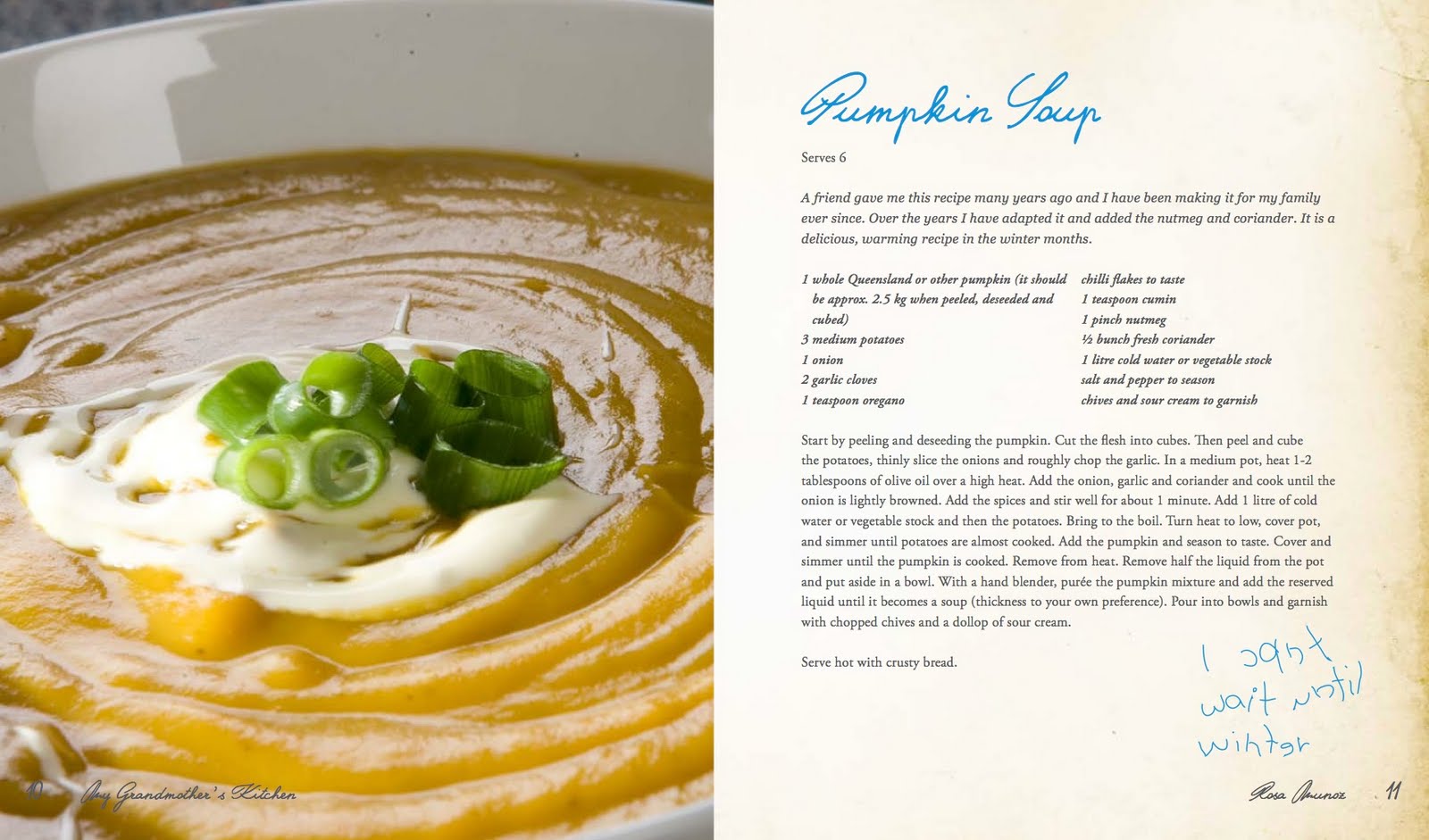
As the seasons in Sydney begin to turn and the weather is cooling down, Laura and Claire thought it would be fitting to share with us a wintry recipe from their book. And a drizzly, cool day like today is the perfect time to try it a warming pumpkin soup...

Rosa Munoz's Pumpkin Soup Serves 6
A friend gave me this recipe many years ago and I have been making it for my family ever since. Over the years I have adapted it and added the nutmeg and coriander. It is a delicious, warming recipe in the winter months.

Ingredients
1 whole Queensland or other pumpkin (it should be approx. 2.5 kg when peeled, deseeded and cubed)
3 medium potatoes
1 onion
2 garlic cloves
1 teaspoon oregano chilli flakes to taste
1 teaspoon cumin
1 pinch nutmeg
½ bunch fresh coriander
1 litre cold water or vegetable stock
salt and pepper to season
chives and sour cream to garnish

Start by peeling and deseeding the pumpkin. Cut the flesh into cubes. Then peel and cube the potatoes, thinly slice the onions and roughly chop the garlic. In a medium pot, heat 1-2 tablespoons of olive oil over a high heat. Add the onion, garlic and coriander and cook until the onion is lightly browned. Add the spices and stir well for about 1 minute. Add 1 litre of cold water or vegetable stock and then the potatoes. Bring to the boil. Turn heat to low, cover pot, and simmer until potatoes are almost cooked. Add the pumpkin and season to taste. Cover and simmer until the pumpkin is cooked. Remove from heat. Remove half the liquid from the pot and put aside in a bowl. With a hand blender, purée the pumpkin mixture and add the reserved liquid until it becomes a soup (thickness to your own preference). Pour into bowls and garnish with chopped chives and a dollop of sour cream.


For more information about Laura Clarke and Claire Wallace, or to buy a copy of the book visit http://www.mygrandmotherskitchen.net/

Their Facebook page also reports on the latest book news and gives you an opportunity to ask questions or contact Laura and Claire direct. Visit www.facebook.com/mygrandmotherskitchen

All photos © Laura Clarke and Claire Wallace

Tuesday, February 22, 2011

When Home is… A Mother’s Cooking. An interview with Food Blogger Jules Clancy


For Jules Clancy, food scientist, self-published cookbook author and creator of the minimalist home cooking blog Stonesoup, cooking has been a passion since childhood.

Little has changed during the intervening years; ‘It's how I relax and unwind but also how I earn my living these days. The thing is I never get sick of it. There are always so many new things to explore and perfect. Food and family are intimately linked for me. It's all about sharing. My boyfriend loves his food as well and we spend hours talking and planning what we're going to cook and eat.’

Growing up as the eldest of five children on a sheep farm, Jules says her mother was an ‘inspirational country cook’. ‘But it wasn’t until I went to boarding school and had to make do with convent food that I realised just how special my mum’s cooking was.’

Jules says that her mother was ‘a pretty classic country Australian cook’; one who created comforting, nurturing classics – roasts, steak, spaghetti bolognaise – that her family never tired of. ‘It was simple but she always used fresh, high quality ingredients. She was also a whizz when it came to cakes and sweet treats. She loved to spoil us!’

And it was ‘something sweet’, such as her pikelet or scone recipe, that Jules first learnt to cook as a small child.


When a little older and at boarding school, Jules and her mum had a ritual; ‘Mum would always make me a batch of lamingtons to take back to school with me after holidays. I used to help her. We'd sit at the kitchen bench and chat and just hang out. My contribution was rolling the lamingtons in the coconut. I still remember how good it tasted licking my chocolatey coconut fingers when we were done.’

Her mother’s kitchen was the centre of the family’s home. ‘It, like me, was a child of the 70s with green linoleum floors and bright yellow bench tops. It had big windows and was always where the action was happening. Everyone used to naturally gravitate to the kitchen. If someone popped in to visit we'd always sit in the kitchen drinking tea. It was rare that our formal lounge room got used.’

After Jules’ mother died suddenly in 2007, Jules decided to pull together a collection of her recipes for family and friends and with the help of her sisters she tested and photographed all the classic family dishes they had grown up with.

It was an easy task, says Jules; ‘My mum was very organised and kept her favourites in a little recipe book so they were all automatically included. It also helped that I have three sisters who also contributed their favourite things that mum had taught them - it was funny but we all remembered different things.’

Once finished, Jules realised she wanted to share her mother’s simple, no-fuss Australian recipes with a broader audience, so decided to self-publish the book to celebrate the ‘recipes that anyone can learn to cook and that everyone will love to eat.’

Titled and the love is free, the book has been well received. ‘I've had some really lovely emails and notes from people who used to eat the same things when they were kids. And some touching notes from people who have also lost their mums to cancer.’

So, was it cathartic to revist her mother’s kitchen without her mother? ‘It was super comforting and fun. I was especially happy when I followed the recipes exactly and they ended up tasting just like mum used to make.’

‘Normally I can’t help myself and tinker with a recipe so naturally things end up tasting different. I felt like mum was in the kitchen with me when I stuck to the recipe - a wonderful reward.’

For those times when Jules wants to feel closer to her mum, she simply cooks her mother’s tuna mornay. ‘We called it tuna dish and when I make it with processed cheese slices it makes me feel like mum made it especially for me.’

Cooking this meal always evokes strong memories such as; ‘Helping mum mash up the tuna with a fork. Sneaking bits of hot penne when mum wasn't looking and licking the bowl while we waited for it all to bake.’

While Jules has her eyes on her jam-making pot and the big ceramic mixing bowls her mother used for mixing the Christmas cake each year, she was lucky enough to inherit her sunbeam mix master. Originally belonging to her grandmother, it is stuck on high speed. ‘This is fine,’ says Jules, ‘because I mostly just use it for making pavlovas or whipping cream’.


As Jules writes in her book, ‘no family recipe book would be complete without a recipe for pavlova or ‘a pav’ as it was known in our house.’

So enjoy this classic Clancy family recipe, particularly as we near the end of summer…

‘The strawberries from Mum’s garden were always the fruit of choice when in season but mixed berries from the shop would also work when we didn’t have access to mum’s bursting-with-flavour fruit. In the height of summer sliced mango and passionfruit were also lovely.’

‘A word of warning. While it seems so easy to be able to leave the pav to cool and finish cooking in the oven, it can be dangerous. Especially if you have an electric oven like my Mum. I remember one time I’d made a pav and left it to cool and then came back a few hours later, completely forgetting what was in the oven and turned it on to preheat for dinner. Woops. Lets just say that burnt pavlova is not a pretty sight.’


2 egg whites
1 1/2C (330g or 12oz) caster sugar
pinch salt
dash vanilla extract
1t white vinegar
1t cornflour
3T boiling water
whipped cream, to serve
fresh fruit, to serve

Preheat oven to 150C (300F). Line a baking tray with baking paper and grease lightly in a circle about 20cm (8in) diameter. Place all ingredients in the bowl of an electric mixer and beat for 10 minutes or until the sugar has dissolved and the mixture is very stiff.

Spread mixture out on the tray to cover the greased circle. Place in the oven and decrease temperature to 120C (250F) and bake for 1 hour. Turn off oven and leave door ajar for pavlova to cool in the oven.

To serve, carefully peel foil from the base of the pavlova and place on a serving platter. Generously smother the top with cream and decorate prettily with fresh fruit.

The pavlova base will keep in an airtight container for a few days but once the cream has been added its best if served straight away.


To find out more about ‘And the love is free’, click here.
To read Jules’ blog, Stonesoup, click
here.

All photos © Jules Clancy

Monday, February 14, 2011

When Home is... a Rickety Cottage and Garden in the Barossa Valley


How do you get a Barossa girl, who at the age of 17 declared ‘I will never move back to the Barossa’, do just that? For Cherie Hausler, it was thanks to a rickety 160 year old cottage ‘looking for the love it deserved.’

‘It’s funny how a place makes its way into your heart and quietly keeps growing there as you go about the business of life experience,’ says Cherie about the decision to move back.


After many years of living overseas and in other Australian cities, Cherie, who met her husband at highschool, felt the long list of memories they had in the Barossa drew them back.

As did the cottage despite its sorry state; ‘just short of sheep running through it’.

‘There was no garden to speak of (see sheep), and layers of patch up jobs in the form of alternating mission brown, antique white and heritage green paint, nearly clouded the beautiful bluestone cottage it originally set out in life to be. Nearly.’

‘There were signs of grander days gone by; the original German bakers oven poking through the overgrown wormwood, a gnarly old apricot tree still managing to bear fruit, and inside the lovely thick walls with deep-set sash windows, and a peak of hundred year old floorboards calling out from under the 70's carpet.’

But it still felt like home, the moment the couple walked in; ‘It immediately had such a nurturing feel to us. Once we felt that, it may not have mattered what the place looked like at all, we knew we had to live here.’

Having lived in the house for the last six years, the couple have made many changes; ‘We have resurrected as much as we could, always paying respect to the age of the property and the history that has gone before us. The cottage is about 160 years old, so we had no intention to modernise it. One of the first things we did was have the layers of paint sandblasted off the stonework and were so excited to see the giant bluestones emerge from the dust!’

‘We have done some basic things like patched walls and filled in missing architraves, and re-plumbed the kitchen. But things like the new cupboards have all been made by local craftsmen who understand the floor and walls may not sit at 90 degrees to each other, and have the skills and sensibility to create a seamless update or replacement.’


‘Floor coverings and ceilings have been replaced (or removed in the case of the floorboards that were hiding in our bedroom) and the whole house has been repainted inside but we are very conscious of not doing 'too much' - it's a farmhouse and we don't want it to lose that humility, it's part of the “come as you are” feeling that makes the house so welcoming.’

As a freelance writer and food stylist, it’s not surprising that the kitchen is Cherie’s favourite room in the house; ‘We have a space that allows people to be involved, or watch from a the dining table, as food is brought in from the garden to the mixmatched tables that make up our kitchen "island".’

‘Having a woodfired oven that heats the room in winter and also turns out some pretty impressive pizzas helps too.’

But it’s also the view from the kitchen window that is perhaps her most favourite; ‘I still get excited to look up from washing beetroot in the sink to see cows looking back at me through the kitchen window. The fact our neighbours are all four-legged definitely hasn't worn thin yet!’


Gardening has always been an interest – ‘we've managed to find some soil to grow something no matter where we've lived and how small the space available’ – but it’s only now they have the space that Cherie has been able to ‘live out the ideal of a big veggie patch and orchard, that I constantly romanticised as a city dweller’.

‘Gardening is such a brilliant way to soften the edges of day-to-day life. Maybe it's too cliche, but that connection to the earth really effects every part of you, whether you choose to notice it or not, it will always make things feel better when your hands are in the soil. Sitting down to a meal made up entirely of what we've grown in our garden always makes me pause a little before eating. There's grace in gardening, for sure.’


This love of gardening has led to a new business venture: Scullery Made Tea. Cherie hand blends her teas using locally grown seasonal fruits and herbs which are dried and combined with whole leaf tea. While always a tea lover, she says, ‘The idea that I could grow a 'patch' of lemon verbena as opposed to a pot of it definitely drove the tea making venture.’

Collecting quite a following, her teas are now sold in cafes and gourmet stores throughout Australia.

Living here has definitely sharpened Cherie’s focus on food as well as tea; ‘Having the chance to grow food and eat by the seasons is something I am constantly inspired by, so it naturally pops up in most of my work one way or another just because I'd rather talk about that than most other things!’

It’s perhaps not surprising that the meal which most says ‘home’ to Cherie is one that is grown in her garden; ‘I know we've all done pesto to death but it really is comfort food taken to a whole new level when you can pick your own herbs. And I'm not talking just basil, although I adore our basil in summer. I love going out to the garden and letting it decide on dinner for me, so throwing in nasturtium leaves, stinging nettles, marjoram, oregano or even calendula can make up pesto in our house.’


‘One of my absolute favourites is stinging nettle pesto, especially as nettles appear the same time as our geese start laying their beautifully rich eggs, so homemade gnocchi is usually part of the deal. This is the world's easiest gnocchi too, regardless of goose eggs or not!’


Stinging Nettle Pesto & Goose Egg Ricotta Gnocchi

‘This pesto recipe is completely and utterly inspired by Louisa Shafia’s in Lucid Food, but I couldn’t believe I didn’t have any garlic in the house, or quite ready in the garden, when I went to make this, so I substituted the garlic with fresh chives and it was so nice I think I might make all my pesto without garlic for a while. It still had that lovely garlicky warmth but without the ‘burn’ that raw garlic can sometimes leave your tummy with. And I used verjuice instead of lemon juice. And threw in some capers. You get the idea.’

‘The ricotta gnocchi is something I’ve been making for so long, because too many of my other gnocchi efforts turned into potato soup, that I make this by feel now so if the quantities aren’t exact, just add a little bit extra of one thing or another.'

'It’s pretty much bullet proof, so there’s quite an amount of leeway to play around before you’d get close to mucking it up.’

For the pesto...
1 bunch unsprayed, organic stinging nettles (or equivalent in basil)
1/2 cup fresh mint leaves
1 bunch garlic chives
1/2 cup pinenuts
1/4 cup verjuice
1 tbsp organic capers
extra virgin olive oil
sea salt

For the gnocchi...
1 free range goose egg, or 2 free range chicken eggs
300g ricotta cheese
1 1/2 cups unbleached organic plain flour
1 cup wholemeal spelt flour
sea salt

parmesan to serve

To make the pesto the only effort will be the initial dealings with the nettles, after that everything goes in the food processor and you’re done.
Make sure you have rubber gloves on or at least use tongs to handle the nettles prior to blanching. They’re quite mean at this stage.
Remove the leaves from the stalks and place into a saucepan of boiling water for only a minute.
Remove and let drain and cool completely.
Once the nettles have been boiled they can no longer sting you so feel free to pick them up in your bare hands and squeeze as much water out of them as possible before putting them into the food processor with the other pesto ingredients and pureeing with enough extra virgin olive oil to make a smooth consistency paste. Season to taste.

For the ricotta gnocchi, mix the flours and salt in a large bowl, and making a well in the centre, add the ricotta and beaten egg(s). Use a wooden spoon to pull the ingredients together and form into a rough ball. Take a handful of the dough, leaving the rest covered in the bowl so it doesn’t dry out, and on a floured bench work it into a long ‘sausage’, about 1 1/2cm in diameter. Use a sharp knife and cut the sausage into gnocchi, slicing through about every 1 1/2 cm. Gently squeeze the gnocchi away from the sausage with your thumb and first finger, as you cut it, to give it a bit of shape. Let the gnocchi sit on a floured board until you have cut all the pieces, making sure to keep them separate so they don’t try to stick to each other.
When all the gnocchi are cut, drop them into a large saucepan of boiling water and cook until they pop their heads up to the surface. This will tell you they’re ready. Drain and serve immediately with pesto, some parmesan and an extra drizzle of olive oil.


To read more of Cherie’s recipes and life in her Barossa Valley cottage, read her blog, here.
To find out more about Scullery Made Tea, visit the website,
here.

All photos © Cherie Hausler

Friday, January 28, 2011

When Home is the Kitchen... an Interview with Food Writer Sara Kate Gillingham-Ryan


Six-and-a-half years ago, Sara Kate Gillingham-Ryan’s husband Maxwell started a blog called Apartment Therapy. His mission is ‘helping people make their homes more beautiful, organised and healthy by connecting them to a wealth of resources, ideas and community online’.
When the blog began, Sara Kate was a food writer. She says, ‘We both believe that if you talk about the health and vitality and style of the home, you cannot ignore the kitchen and the cooking that goes on there.’

She began writing a weekly food column for Apartment Therapy. ‘When I had time, I wrote more. I was also doing freelance print writing. At a certain point we held our breath and took the leap for a dedicated cooking site. That was five years ago. We haven't looked back.’

And so began The Kitchn, an inspiring blog filled with food information, recipes and kitchen tours. With more than one million readers, it is obvious that many of us believe that a kitchen is central to our feelings about home.

For Sara Kate, her favourite kitchen is the one she cooks in now; ‘It's where I feed my family every day. It's not fancy. I have a pretty crappy 24" stove and a small refrigerator, one drawer, two upper and one lower cabinet all along one wall. Then a long Ikea butcher block for chopping and serving. But from it I sustain my daughter's life and her love of food, so for that reason, it wins.’

‘My least favourite kitchen was probably the one I had in a shared apartment before I was married. Roaches, ants, you name it. New York City shared living at its best.’

Having a small kitchen means that Sara Kate is forced to ‘pare down constantly. I don't have anything that I don't use.’

What she loves most about the kitchen is it’s ‘(tiny) skylight’. ‘I can watch the sun pass, sometimes a full moon, and pelting rain. I also love that the "bar" (butcher block) allows people to be in the kitchen with me without being in the way.’


Anytime is a good time to be in her kitchen; ‘Whenever something is cooking. Also, that time when the sun passes over the skylight. The light is magic.’

Although the family has a small, round dining table, they have most of their meals at ‘the bar’.

Since becoming a mother, Sara Kate’s feelings about her kitchen have not changed. ‘It has only reinforced my belief that cooking is one of the most important things we can do for our children.’

For Sara Kate, the kitchen will always be the heart of the home; ‘It feeds us. We need that to be alive, and we also get so much pleasure from it.’

As for a favourite meal to cook in her kitchen? It’s Sara Kate’s mother’s Italian Wedding Soup.
‘When it comes to soups, I can easily say I have a hands-down favorite. My vote for this soup is heavily influenced by nostalgia; it was one of the first real meals my mother fed me when I was a baby. The legend is that I'd slurp it loudly and the broth would dribble down my neck and into my clothes.

The recipe was handed down to my mother, and adapted at each stop, from a man named Fran, whose daughter was my first babyhood friend. I don't really remember Fran — he passed away when we were still tiny — but he lives within me every time I make this soup. Now I feed it to everyone — from my own little person, who also slurps and dribbles it, to Saturday night company, who usually use a napkin.

We always call it Italian Escarole Soup, but it's also known as zuppa di scarola, or Italian Wedding Soup because it is a traditional course at Italian nuptials. It is simple to prepare, but has enough flourishes — herby meatballs and a last-minute addition of cheesy egg ribbons — to make it special enough for guests.

Italian Wedding Soup is highly adaptable; try other greens like kale (as I did in the photo below) or chard, add grated lemon rind to the meatballs and some lemon juice to the broth for brightness, or consider spicing it up with some ground red pepper flakes added with the onions and garlic.’

Italian Wedding Soup

Serves 6-8

3/4 pound ground organic meat (chicken, turkey, pork or beef)
1/2 cup dry bread crumbs
3 large eggs
1/2 cup grated Romano cheese, divided
1/2 cup grated Parmesan cheese, divided
1 tablespoon chopped fresh oregano (or 1 teaspoon dried)
1 teaspoon salt
1/2 teaspoons freshly ground black pepper
3 tablespoons olive oil, divided
1 medium yellow onion, diced
4 cloves garlic, minced
8 cups chicken stock
1 bunch greens trimmed and torn into bite-sized pieces (about 6 lightly packed cups)

Combine the ground meat, bread crumbs, 1 egg, 1/4 cup of each cheese, oregano, salt and pepper in a bowl. Mix thoroughly, then form the mixture into 3/4-inch to 1 1/2-inch balls. You should have 20 to 30 meatballs, depending on how large you form them.

In large skillet, heat 2 tablespoons oil over medium high heat. Add the meatballs in batches, and cook, turning, until browned all over, 3 to 5 minutes. (If they are still a bit pink in the middle, don't worry, they will continue to cook in the broth.) Set them aside on paper towels to absorb excess oil.

In a 4 to 6 quart soup pot, heat the remaining 1 tablespoon oil over medium high heat. Add the onion and garlic and sauté until onions are tender and garlic is soft, but not browned, about 5 minutes. Add the stock and bring to a boil. Add the greens, reduce the heat to low, cover, and simmer for 10 minutes. Add the meatballs and cook another 5 minutes.

Meanwhile, combine remaining 2 eggs and remaining cheeses in small bowl and stir with a fork to blend. Slow pour the egg mixture into hot soup, stirring constantly. Cover and simmer just until egg bits are set, about 1 minute. Season to taste with salt and black pepper, maybe even a squirt of lemon juice, and serve immediately in a low bowl if possible so the meatballs are visible.

To re-heat, simmer gently over low heat.


To receive more of Sara Kate’s recipes, cooking tips and stories, subscribe to The Kitchn here.
To follow Sara Kate on twitter, click
here
To find out more about Apartment Therapy, click
here

Sara Kate also has a new recipe book coming out next week, February 1st. Good Food to Share is available here.

Photos of Sara Kate and her kitchen © Sara Kate Gillingham-Ryan
Photo of Italian Wedding Soup and recipe reprinted courtesy of The Kitchn

Saturday, December 18, 2010

When Home is... Reindeer Food


It’s been a busy month at my home – like all homes at this time of year. There have been preschool nativity plays, ballet concerts, school parties, final assemblies, and for me, a commission to write a piece about the history of our house for a magazine... all of this coinciding around the same time.

But now school and preschool are over, my article is with sub-editors, presents are – nearly – all bought and we have time to just ‘be’ at home. Everyone is exhausted and the weather is warmer so this week has seen the re-emergence of our blow-up pool, staying in pyjamas all morning and not thinking about what to have for dinner until... well... dinner time.

The tree is decorated, our wreath on the door and stockings by the fireplace. Almost all our Christmas preparation traditions are complete. Everyone has different traditions, some handed down through generations of family and some begun only in this generation.

For my children, a new tradition began two years ago when my son came home from preschool with a bag full of ‘Reindeer Food’. On Christmas Eve the children scattered it across the grass and out of their bedroom window ‘so the reindeers could see our house from the sky and have something to eat while Santa filled the stockings’. It was much more exciting for them than leaving the carrots next to Santa’s biscuits and whiskey by the tree.

The following year they asked to make it for friends who we spend Christmas ‘Eve Eve’with, whose children they have known all their lives. It worked well for these friends, that Christmas the reindeer left a trampoline as thanks for the treat.

This year, they also made a jar for friends to take interstate. Hopefully it travels well.

It’s become a pre-Christmas ritual they enjoy as much as decorating the tree. It’s family rituals such as these that make a house a home and there are never more individual family rituals than at Christmas time.

Merry Christmas to all. I will be writing many more interviews in the new year and thank you to everyone who has left comments, sent emails, suggested interview subjects and actually reads what I write! It’s been a fun six months and I look forward to growing the blog in 2011.

And, if you’re interested in the ingredients of Reindeer Food, a recipe is below...

Reindeer Food
6 tbsp natural oats
4 tbsp red lentils
A handful of shimmery stars
A dash of gold glitter
A smattering of red and green glitter
A sprinkling of 100s & 1000s

Place all ingredients in a jar or snap lock bag. Seal and shake.
Leave in a cool, dry place until Christmas Eve, then spread evenly over the garden / lawn / courtyard.
Listen out for reindeer bells.

Merry Christmas!

Tuesday, November 16, 2010

When Home is... Cookbook Author Tessa Kiros’ Kitchen


You can’t miss the child’s red shoes that adorn the cover of Tessa Kiros’ cookbook Apples for Jam. Her book stands out amongst the hundreds of other cookbooks appearing on the shelves in bookshops because those slightly scuffed, well-worn shoes suggest that behind this cover lies something more than lists of ingredients and cooking methods.


I recently showed a friend of mine who is an amazing cook this book... just as she was leaving after a cup of tea. She opened it up and within seconds closed it again.

‘Oh no, don’t do this to me’, she said as she stroked the cover – those shoes – ‘If I start now I’ll need to read the whole thing in one go!’

And she’s right. Another friend had loaned it to me and I lost a few hours of the afternoon inside its covers. And I keep dipping back. It’s not just for the food but the story Tessa weaves in and around the recipes. Here are those stories of life; universal memories of childhood, moments of motherhood, of creating a sense of family and the security of home through the meals you cook for those you love.

And to top it off, she lives in Tuscany.

Having worked as a chef in London, Sydney, Athens and Mexico and travelled the world, Tessa’s food is a rich blend of many different cultures. She is also the author of five other cookbooks, the most recent being Food From Many Greek Kitchens. While Apples For Jam is about the recipes she remembers from childhood and those she cooks for her own children, her latest book sees her visit the Greek kitchens of her friends and family.


But today we are visiting her kitchen; the one she shares with her husband and two daughters in the hills of Tuscany. And while we’re in the kitchen, why not start with what it’s like to cook there.

‘Italy, or at least where I live – in the countryside in Tuscany has wonderful ingredients. It is difficult not to notice what the earth is giving us all the way through the year. The slow and steady cycle of things here. The repetition each year. In that way for me it is different from living in an international city where almost everything is available.’

So what does Tessa enjoy cooking the most? ‘There are many meals depending on the time of year. In Summer we love barbecues; huge salads outside and ice cream and picnics in the garden. In Winter we’re inside around the fire; roasts, roasted vegetables, mashed potatoes, pies... I love pies for the family in winter, and warm crumbly kind of desserts with a splash of colour... yes that would cheer things up.’

The kitchen has always been the heart of the home for Tessa. And not just for cooking, ‘Whether it be to sit at a table with tea and biscuits and friends, or spend time in alone... The kitchen for me should flow into the rest of the home.’

After becoming a mother, she found that her thoughts about food and cooking changed, ‘Nourishing young ones is a grand responsibility and a wonderful opportunity. I shop mainly for organic produce these days and since being a mum I am far more aware and more careful about what I will serve. I see food now also as the building blocks and the fuel that we need to proceed. Not just the sheer enjoyment side of it. I try and twirl them together now.’

In Apples for Jam, Tessa likens feeding a family to ‘stitching all the bits together on a steady thread'. As she explains, ‘It’s about holding it altogether. If that is our job for now then let us do it well. Once our place is to prepare the meals we should splash them with love and any extras that we can and still do it elegantly. Nobody wants to know the other details. Just if you did it and if you did it well. A family has many needs. Varying dynamics. Sometimes we need to rise above and take in what we need to do instead of getting stuck in the stickiness of it all.’

What food memories does she hope to leave with her daughters? ‘I would like them to know about food, where it comes from and that what we put into it – our efforts, our beliefs are what will show up in our pots and on our plates. I would like them to remember tasting different ingredients, food from different cultures and above all to have their own lovely warm and aromatic memories of what they loved as children all the way through their adulthood – not that it was a drag and they had to eat zucchini.’

Not surprisingly, Tessa’s feelings about home have always been and will always be closely intertwined with food; ‘For me home is a cosy open place, where people join at meals especially or over tea. The family materialise out of their various corners for lunch or dinner and then often disappear again. Bringing them all together in this way has an almost magical quality to it.’

Her most favourite time of year in the kitchen? ‘Christmas at home I love.’

Luckily Christmas isn’t too far away so what better excuse than to include a festive recipe from Tessa’s latest cookbook, Food From Many Greek Kitchens.


KOURABIEDES BUTTERY ALMOND CAKES
These are icing sugary/buttery, and melt-in-your-mouth honest bundles enjoyed at Christmas.

Makes about 22
50 g (1¾ oz/1/3 cup)
almonds, skin on
250 g (9 oz) unsalted
butter, room temperature
2 tablespoons icing (confectioners’) sugar
1 egg yolk
1 teaspoon vanilla essence
1 tablespoon brandy
300 g (10½ oz/2 cups) plain (all-purpose) flour
1 teaspoon baking powder
about 250 g (9 oz/2 cups) icing (confectioners’) sugar, for dusting

Coarsely chop the almonds into small pieces. Toast in a dry frying pan over a low-ish heat until just coloured. Cool.

Whisk the butter in a bowl using electric beaters until it is very pale and thick, about 8 minutes.

Add the icing sugar and whisk it in well. Add the egg yolk, vanilla and brandy and whisk them in well too.

Sift in the flour and baking powder and beat them in until you have a smooth dough which is hard to keep mixing with the beaters. Add the almonds and mix them through with your hands.

Press the dough into a ball, cover with plastic wrap and refrigerate for 30 to 40 minutes.

Meanwhile, preheat the oven to180°c ( 350°f / gas 4 ) and line a baking tray with baking paper.

Break off pieces of dough, about 30 g ( 1¼ oz ) each, and roll them into balls, slightly flattening the tops.

Put them on the tray allowing a little space between each one. Bake until lightly golden, 20 to 25 minutes.

Remove from the oven and let cool on the tray for about 15 minutes.

Dust about half of the icing sugar onto a tray or large plate or your tin where you will store them.
Gently move the kourabiedes to sit in a single layer in this, then sprinkle the remaining icing sugar over their tops so that they look like they are snowed in. Will keep in a tin for many days.


Recipe and images from Tessa Kiros: Food From Many Greek Kitchens, published by Murdoch Books RRP $69.95

All other images courtesy of Murdoch Books

For more information about any of Tessa’s cookbooks, click here.

Sunday, November 14, 2010

When Home is... a Change in Breakfast Routine


Why does it seem wrong to have your normal weekly breakfast on a Sunday? On those Sundays when I do just throw a couple of slices of bread in the toaster and pour a mug of tea while pulling out the boring Weet-bix carton from the pantry for the kids, I find the day feels distinctly un-weekend-ish.

On a Sunday when one of us does pull the carton of eggs out of the fridge or finds a packet of bacon in the back of the freezer, the day feels much less structured and full of possibilities. Strange, given that there are only so many ways a Sunday can be full of possibilities with three children and one who sleeps in the afternoon but there you go: the power of bacon.

Today there was no packet of bacon. There was a tub of fresh ricotta, however, and a husband who reached for Bill Granger’s ricotta hotcakes recipe. What better way to mark a Sunday and particularly fitting as I am currently writing up an interview with cookbook author Tessa Kiros. It wouldn’t feel the same if I was eating a buttered slice of slightly stale multigrain while writing about her kitchen in the hills of Tuscany, would it?!

Her interview will be posted shortly, but in the meantime here’s that Sunday Ricotta Hotcakes recipe... the only downside was that with five of us there no longer seems to be quite the same number of hotcakes to go around.


Bill Granger’s Ricotta Hotcakes (taken from Sydney Food)
1 1/3 cups ricotta
¾ cup milk
4 eggs, separated
1 cup plain flour
1 tsp baking powder
Pinch of salt
50g butter

Method
Place ricotta, milk and egg yolks in a mixing bowl and mix to combine.
Sift the flour, baking powder and salt in a bowl. Add the ricotta mixture and mix until just combined.
Place egg whites in a clean, dry bowl and beat until stiff peaks form. Fold egg whites through batter in two batches, with a large metal spoon.
Lightly grease large non-stick fry pan with a small portion of the butter and drop two tablespoons of batter per hotcake into the pan. Cook over low to medium heat for two minutes or until hotcakes have golden undersides. Turn hotcakes and cook on the other side until golden and cooked through.

Monday, October 11, 2010

When Home is... your mother’s gravy recipe


Recently I was at my mother’s house for dinner along with my sister and my sister’s godparents from interstate. Mum had made a roast – albeit with mash potato rather than roast which was my first shock of the evening – and just as the meat was ready my mother asked my sister to help with the gravy.

My initial reaction was to wonder why she asked my sister when surely she knew as little about making gravy as me. But then as she deftly whisked away with a fork I realised that she knew exactly what she was doing.

‘How do you know how to make gravy?’ I asked accusingly as only a big sister can.

‘What are you talking about? Mum taught me of course.’ She looked at me curiously. ‘Didn’t she ever teach you?’ she said in a way that only a younger sister can.

‘I’m sure I’ve shown you how to make gravy’, my mother interrupted shaking her head at us.

Um, no. White sauce yes, gravy no.

How is this possible? As a lover of roast dinners how have I gone through adulthood without making a gravy?

It’s funny how there are some recipes that you learn from your family rather than a recipe book. And if you miss out before you leave home you may never master. What I love most about such recipes is that every family probably has a slightly different version thanks to generations of tinkering to please different palates.

I suspect the reason why I never learnt to make gravy was that it’s not my favourite part of a roast dinner anyway. I never liked the gravy seeping into my crispy roast potatoes and I still don’t. For me a roast dinner has always been about the potatoes.

But I think it’s time I grew up and at least had an idea about how gravy comes to appear on the table. After bringing up the gravy conversation again with mum (‘You should just know after watching me make it for all those years.’) I learnt that she makes it the same way my poppa does as my nanna always made it too thick, lumpy and pale. At least nanna’s way would mean that it wouldn’t leak into my potatoes.

So, finally I have our family’s gravy recipe. Whether I attempt it will be another question. After all, a family recipe always tastes better when it’s made by your mother, doesn’t it?

Mum’s Gravy

Sprinkle enough SIFTED plain flour (I just use a metal tea strainer) to cover the bottom of a hot frying pan (this can be done in a dry pan or otherwise the baking dish & juices once the meat is
resting).

Watch it carefully as it starts to brown without being tempted to move it around! As you see it change colour - not too dark, the safest way is to take it off the heat and add enough beef stock slowly, stirring all the time (or even using a whisk) to make sure it does not go lumpy (putting it back on the heat as you add more stock).

When it is the consistency you want & just at boiling point ... not too thick and not too thin, take it off the heat. When the beef is rested & carved, pour the juices from the carving tray back into the gravy & re-heat ready to serve in a 'gravy boat' of course!

I think I remember that Poppa's secret ingredient was adding a touch of Worcestershire sauce at the end.

Monday, August 30, 2010

When Home is... a Food Parcel


Two of my friends are heavily pregnant at the moment with their second children. One lives interstate and has suffered awful rib pain this time around; the other is on crutches due to pelvic pain. Thinking about them brings back the more unpleasant memories of late pregnancy but also the more pleasant ones of friends arriving with food parcels during that time.

Gifts of food are a bit like flowers: they are constant throughout the highs and lows life throws at us. I remember after our first baby was born, a very special friend arriving with small portions of her delicious lasagne and pasta sauces to stock in the freezer. When I think of my daughter’s early weeks, the taste of that lasagne is as memorable as her newborn baby smell.

After our second baby arrived another friend came to visit with a homemade curry, a small tub of natural yoghurt and a packet of pappadams. I remember being so appreciative of the extra touch with the side dishes. With two small children herself it seemed beyond thoughtful.

Eating food someone else has taken the time to cook and package up for you, for you to enjoy at a later date without them, is a most loving gesture of friendship. And perhaps most loving during times of hardship.

Joan Didion, in her wonderful memoir, The Year of Magical Thinking, wrote about a book of etiquette written by Emily Post in 1922. In her chapter titled Funerals, she discusses food and the bereaved. ‘Food, but very little food may be offered... tea, coffee, bouillon, a little thin toast, a poached egg.’ After the funeral friends are advised ‘it is also well to prepare a little hot tea or broth and it should be brought to them on their return without their being asked if they would care for it. Those who are in great distress want no food, but if it is handed to them, they will mechanically take it, and something warm to start digestion and stimulate impaired circulation is what they most need.’

Didion herself writes, ‘When someone dies, I was taught growing up in California, you bake a ham. You drop it by the house.’ But when her husband John died suddenly, ham was not what she wanted. ‘I will not forget the instinctive wisdom of the friend who, every day for those first few weeks, brought me a quart container of scallion-and-ginger congee from Chinatown. Congee I could eat. Congee was all I could eat.’

For me it was soup, after my father died. Perhaps because it’s easy to swallow around the permanent lump of grief that feels stuck in your throat in those early weeks or perhaps it’s the image of soup bubbling away on the stovetop in a friend’s home creating those comforting but gentle fragrances. Smells that will be packaged up and passed over your doorstep only to be recreated on your stovetop, in the comfort of your home. Such an evocative way to be reminded that you are loved and cared for.

Chicken Soup

Ingredients (serves 4)
4 (about 900g) chicken thigh cutlets, excess fat trimmed
1 large brown onion, halved, finely chopped
1 large carrot, peeled, finely chopped
1 celery stick, trimmed, finely chopped
2 large garlic cloves, finely chopped
2 tbs finely chopped fresh continental parsley stems
6 sprigs fresh thyme, leaves picked
2L (8 cups) water
1/2 tsp whole black peppercorns
Sea salt flakes
1/4 cup finely chopped fresh continental parsley, extra

Method
Combine chicken, onion, carrot, celery, garlic, parsley, thyme, water and peppercorns in a large saucepan over medium-high heat. Bring to the boil. Reduce heat to low and cook, covered, for 40 minutes or until vegetables are very tender.

Use tongs to transfer the chicken to a clean work surface. Hold with tongs and cut the chicken meat from the bones. Discard bones. Finely chop the chicken meat and add to the soup.

Taste and season with sea salt. Ladle soup among serving bowls. Sprinkle with extra parsley and serve immediately.


Recipe can be found here

Saturday, July 31, 2010

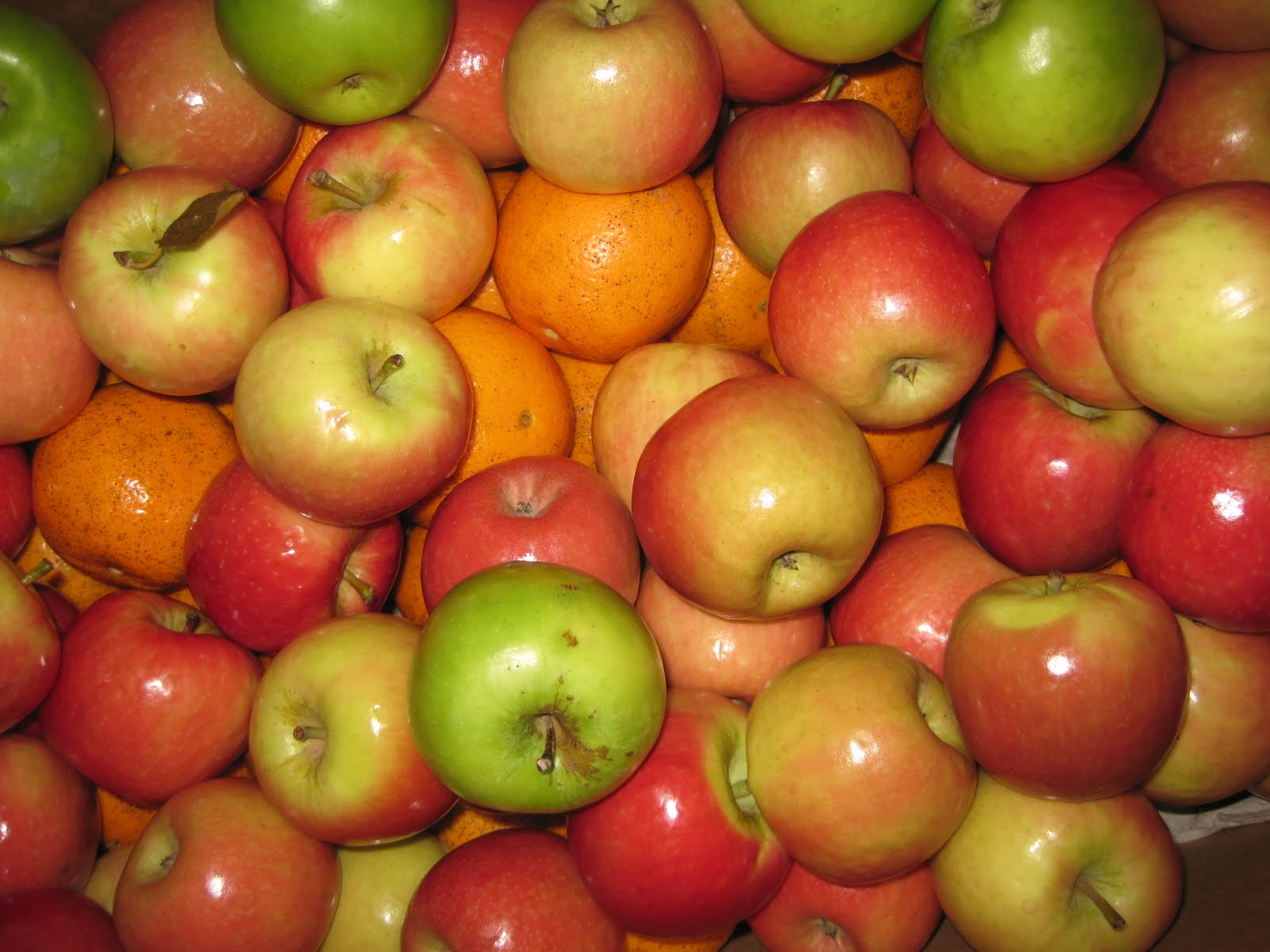
When Home is Apples... lots of apples


We had an unusual visitor at 7.15am on Wednesday. A farmer with a truck full of apples and citrus saw my husband leaving for work and decided to stop ‘in case we needed any fruit’.

Well yes, we always need fruit but I had a feeling that he didn’t mean three apples here, 2 oranges there.

‘It’s just a box’ said my husband excitedly adding in words such as ‘organic’, ‘pesticide-free’, ‘never frozen’ and ‘picked yesterday’. As I spread Vegemite onto toast I considered that a box would probably translate to quite a few apples but I also hadn’t finished my mug of tea so I decided to let him deal with the farmer.

Well, I can now say from experience that a box of apples = LOTS of apples. ‘How are we meant to eat all this?’ I asked as my husband dropped the box onto the kitchen table.

‘We’ll get through it. The kids love apples’, he said over his shoulder as he left for work.


This is true, the kids do love apples (they’re the only fruit Ned will eat at the moment) but there are only three of them. Not 30. So after sending each child off into the world for the last couple of days with an apple for recess and another for lunch; after offers of apple on porridge for breakfast; of pork and apple sauce for dinner; of stewed apple for dessert... we still have LOTS of apples.


Luckily, there is a chapter devoted to apples in Stephanie Alexander’s The Cook’s Companion. It’s a short chapter, unfortunately, but there is a tasty looking apple cake I plan to bake this weekend. And as it is a weekend, I thought it would be fun to share the recipe in case anyone else has a kitchen full of apples... if you don’t, I really do have more than enough to share.


Quick Apple Cake
2 cups peeled & chopped apples
2 tbsp Kellybrook Winery apple brandy, brandy or rum
140g unsalted butter
160g plain flour
1tsp baking powder
3 eggs
120g castor sugar

Method
Soak fruit in chosen spirit for 30 minutes.
Preheat oven to 200°C.
Butter a 24cm ring tin or 22cm round cake tin.
Melt butter & allow to cool
Sift flour & baking powder
Beat eggs & sugar until thick and fluffy and fold in flour mixture gently.
Drizzle in melted butter, then fold it in
Fold in apple & any juice
Spoon into prepared tin and bake for 40 minutes until cake is golden brown & tests clean
Serve warm or cold with cream

Recipe taken from The Cook’s Companion by Stephanie Alexander, Viking, 1996

Wednesday, July 21, 2010

When Home is... a Family Recipe


Patricia Fisken hasn’t lived in Scotland for a number of years but she still takes comfort in cooking the dishes handed down through the generations of her family. ‘My family love food and any get together always and still involves food. My Grannies and Great Aunts all had their signature dishes, which were brought out on every family occasion. My mum has continued this tradition and I hope to do the same.’

Food is so closely tied with Patricia’s sense of family that she compiled a ‘family recipe book’ a few Christmases ago. Recipes from her immediate and extended family were included and Patricia was amazed at how many people sent her the same recipe, which reminded them of that relative. ‘The other interesting thing was the realisation that some recipes had travelled the length and breadth of the world.’

One such recipe is her Granny Thornton's shortbread. ‘There was a moment of panic when neither my mum nor I could find the shortbread recipe and we contacted everyone we knew who may have it. Finally, a relative in Australia sent it over to us saying Granny made it on one of her visits to Britain and she loved it so much that she got the recipe.’

For Patricia, this recipe in particular evokes strong childhood memories. ‘We always visited Granny for the summer school holidays and I distinctly remember the smell of her shortbread (always freshly baked just before our arrival) wafting down the stairway as we approached her house. Granny's shortbread was very distinctive. It had a marzipan-like taste, due to the almond essence she put in it.’

‘It was such a comforting smell and full of promise: of hours sitting with her while she reminisced over photos of her exotic life.’

Exotic stories included how she ran away from her strict convent school to join the South African Women's Army. ‘It was on an army ship out to Egypt that she met my grandfather, a Major in the British Army. He was 20 years her senior and engaged to someone else, but my granny was a very alluring young woman and she ended up capturing his heart and becoming his wife. After the war they settled in Kenya, where they ran a coffee plantation and raised three young children (including my dad), before being forced to move back to Britain because the Mau Mau made it too dangerous for them to stay there.’

‘It is funny how, when I baked the shortbread last Sunday, the memories all flooded back and I was in granny's house, sitting next to her on her sofa, drinking tea, eating shortbread and being enthralled by her tales of life in Africa.’

For Patricia this is the beauty of a well-loved family recipe, ‘It can transport you back to another place, one that was home for a time.’

Here is the unadulterated recipe for Granny Thornton's Shortbread:

Ingredients
3oz castor sugar
6oz butter (soft)
9oz plain flour
1tbsp ground rice or semolina
1tsp almond essence
Pinch salt

Method
Heat oven to 325 degrees fahrenheit
Mix dry ingredients together. Add butter with almond essence (chop up into small pieces with a knife first)
Work mixture with hands until resembles scone mixture
Put into a baking tin and knead into shape (in the tin)
Fork all over
Put in heated oven for half an hour
Then move to next shelf down and turn oven off. Leave for another quarter hour
Take out of oven and sprinkle with castor sugar
Cut into 8 pieces

Photo by Patricia Fisken

Sunday, June 20, 2010

Homesickness cure... a Roast Chook


Jane and Tim Nice along with their three children have lived in New York for four years... and counting (well, I am counting since they are among our closest friends, we are godparents to each other’s children, their first son and our first son were born a month apart... anyway, this is meant to be about their homesickness not about me missing them so I’ll stop carrying on).

Over the years, Jane and I have had countless conversations about differences between Australia and America, and many more about how much she misses home, family and friends. So, I wonder... is there a meal she craves when she’s feeling particularly homesick; one that takes her straight back home?


‘It’s funny, but I always associate comfort food from home as something my mum used to make when I was growing up rather than food Tim and I used to eat as a young married couple in Sydney before we moved here’, says Jane. ‘Of course, we have barbecues over here all the time and it does remind us of Australia, but generally we only have 100 days of warm weather and although we have tried barbecuing in the cold, the barbecue sometimes doesn't even come to temperature (we are only allowed electric grills - no gas) because it is below freezing.’

The dish that Jane and Tim cook as real comfort food, while not necessarily ‘Australian’, is one Jane’s mum used to cook on a Sunday night when she was growing up: roast chicken. ‘I get mum to make it every time she visits because no matter how hard I try, I can't seem to replicate her homemade gravy. I don't know what it is about having your mum cook for you but in some respects I guess it makes me feel like a kid again and forget the responsibilities I have as a mum of three now. I think it is also the familiarity of the meal; you know what you are going to have and how it is going to taste that brings about a sense of real comfort.’


‘Whenever we have a roast (and it isn't every week like it was when I was growing up) our dinner conversation generally revolves around Australia - growing up in Australia and funny anecdotes about our childhoods. Although we may have changed how we do a roast since my childhood days, it still conjures up feelings of home and the comfort that home brings.’

Tim is the chef in the Nice household and he always prepares the roast and the gravy (it’s a big responsibility knowing it’s Jane’s favourite but she seems pretty happy). Here is his recipe:

Sunday Roast Chicken & Veg

For the Chicken:
1 roasting chicken enough to feed your crowd
5 slices of proscuitto
100g of butter
fresh rosemary
fresh thyme
2 bulbs of garlic
1 lemon
salt
pepper
olive oil

Wash and dry the chook thoroughly, inside and out. Then salt and pepper. Chop the herbs finely, zest the lemon and crush the garlic. Mix this stuff with the butter. Quarter the lemon and place inside the chook cavity. Gently put your fingers between the skin on the breast on both sides of the breast bone, creating a pocket: stuff some of the butter under the skin on both sides. Put the remainder on the outside skin including the drumsticks. Put the proscuitto slices over the top of the breast. Then using a little bit of olive oil, cover the rest of the skin. Tie the ends of the drumsticks together. Put it into the oven, in a pan on a rack, at 400F/200C for as long as it takes to get the juices from the thigh meat to run clear. Throw veges like carrots and onions in this pan after about a quarter of the cooking time.

For the starchy stuff (spuds and pumpkin): I bring them to the boil then immediately drain and put back in the pot to dry them out a bit. Dress with olive oil, salt and pepper. Take another roast pan and heat some olive oil on the stove top and then throw in the spuds and pumpkin for a minute before putting them in the oven. They need to cook as long as the chook - or not.

For the gravy: once you take the chook out of the pan, drain off some of the fat and juice from the roast pan, but not all. Use a big spoon of flour and throw that in the pan and stir it into to make a paste. Then add some water or chicken broth - start making a looser paste and then apply gentle heat (on the stovetop). Add more liquid until you get the consistency you want. You might need to strain it before putting it in the gravy boat. The more sticky stuff you have in the pan, like onions, the more flavour you will get. Use salt and pepper to season.

And there you go. Make sure the chook is cooked, the spuds are dark and sticky and the veges are to your liking.

Tim’s final word of advice: Pray your gravy is as good as your mother-in-law’s.

LinkWithin

Related Posts with Thumbnails